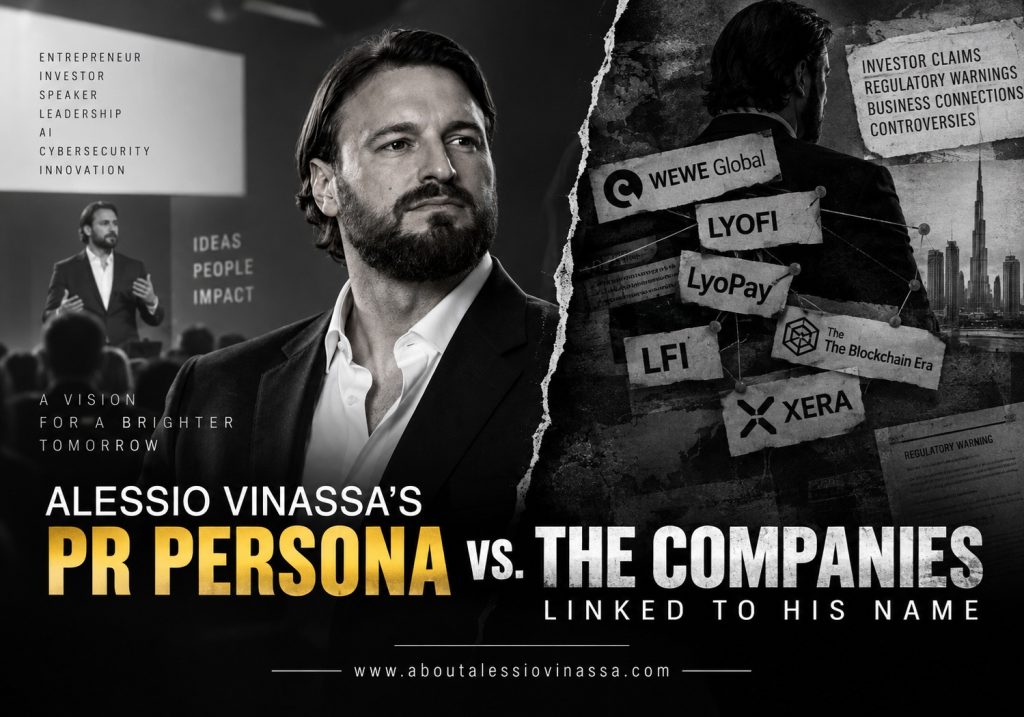
There are really two versions of Alessio Vinassa online.
The first is the version you are likely to see if you search his name today. He is described as an entrepreneur, angel investor, technology builder and thought leader working across artificial intelligence, cybersecurity, Web3, innovative finance and emerging technology. His current profile talks about strategy, leadership, long-term value and investing in new technology. BlockTech Group describes him as an entrepreneur and angel investor with experience across cybersecurity, AI, innovative finance, Web3, gaming and digital business.
The second version is much harder to find if you only read the newer promotional material.
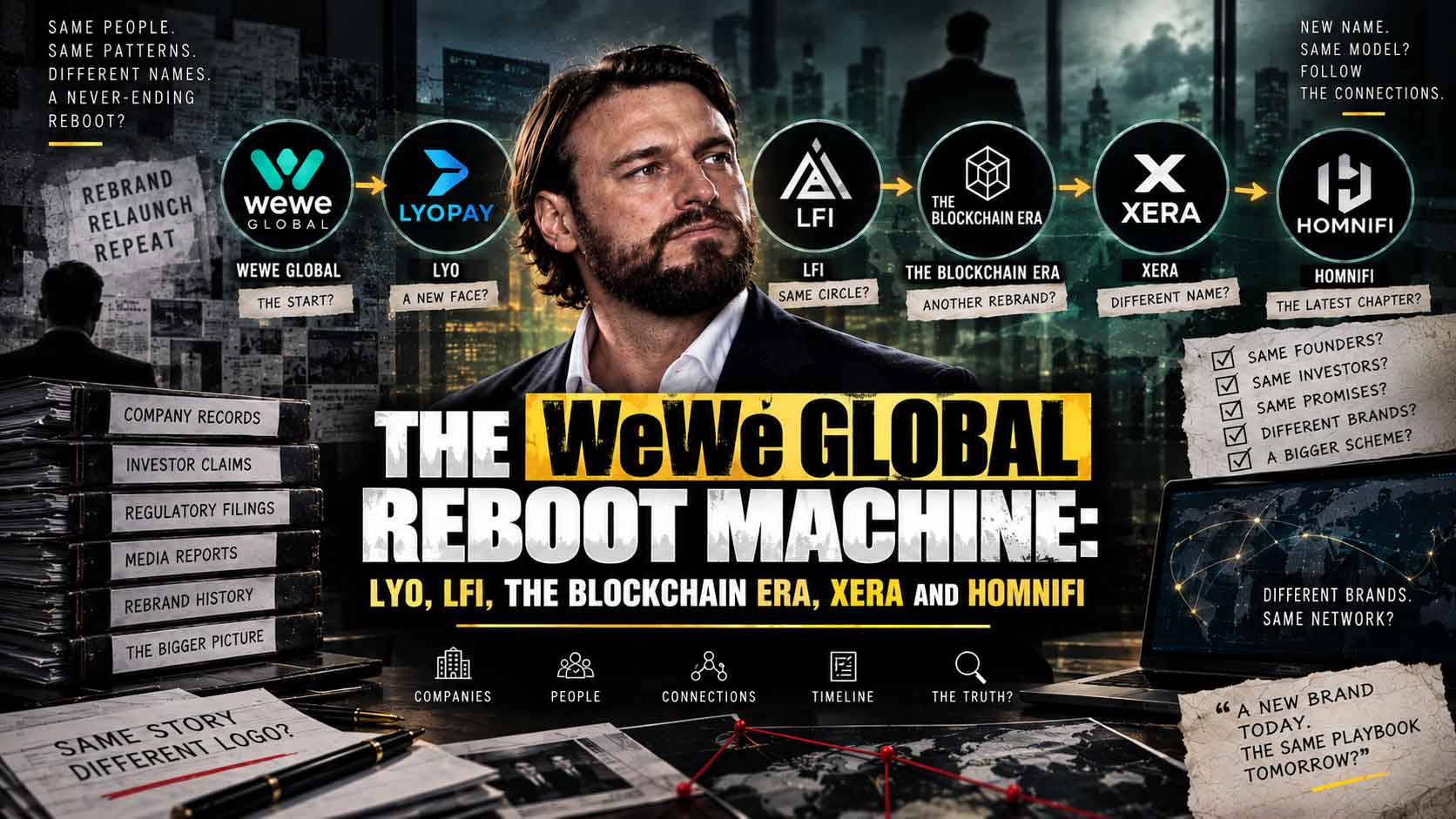
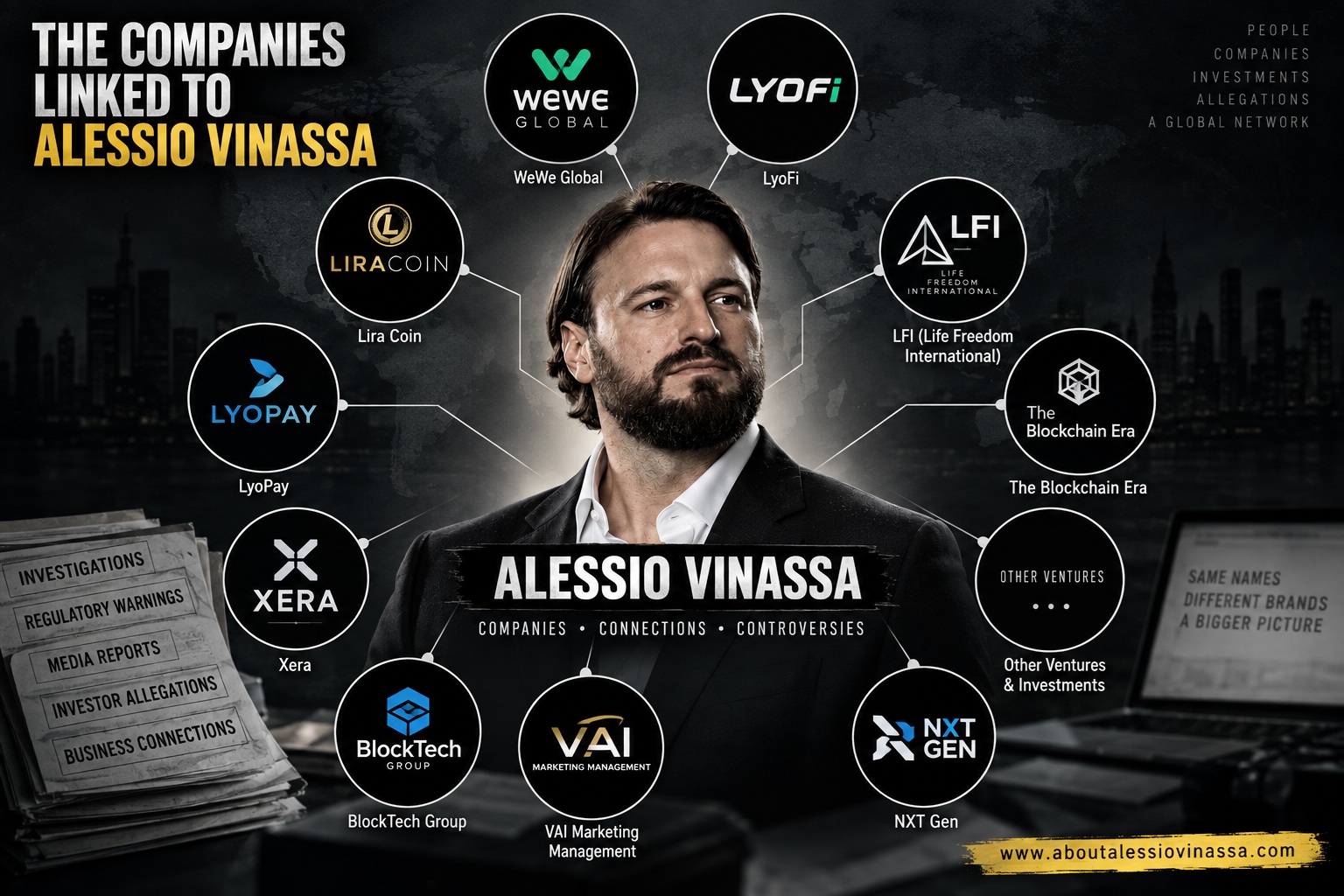
That version is connected to a long list of cryptocurrency projects and companies that appeared, changed structure, collapsed or re-emerged under new names. WeWe Global, LyoFI, LyoPay, LFI, The Blockchain Era, Xera and Homnifi all appear somewhere in that history.
The interesting part is not simply that these names exist. Crypto entrepreneurs are allowed to fail. Companies shut down. Projects get restructured. Businesses change names. None of that, by itself, proves misconduct.
What makes this history worth investigating is the repeated overlap between the projects, the people involved, the products being promoted and the regulatory warnings that followed.
At the same time, Vinassa’s current public image has moved in a very different direction.
That contrast is what this article is about.
The Alessio Vinassa being presented today
The current presentation is polished and fairly easy to understand.
Vinassa is positioned as someone who has spent years working at the intersection of technology and investment. His biography talks about cybersecurity, artificial intelligence, Web3, digital infrastructure and emerging technologies. BlockTech Group describes him as a founder and angel investor and presents his work around strategic thinking, international markets and long-term value.
His more recent media appearances and PR articles follow much the same pattern. The subjects are AI, leadership, innovation, investment strategy, adaptability and the future of technology.
It is a much broader and more respectable-looking business story than the one you encounter when you start digging through the older cryptocurrency ecosystem. And this is where I think readers need to slow down.
A PR article tells you how someone wants to be presented. It does not necessarily tell you the complete history of the person being presented.
That distinction becomes particularly important when a person’s earlier business history involves companies that attracted regulatory attention.
Then there is the company history
If we move away from the current biographies and start following the companies instead, the story becomes considerably more complicated.
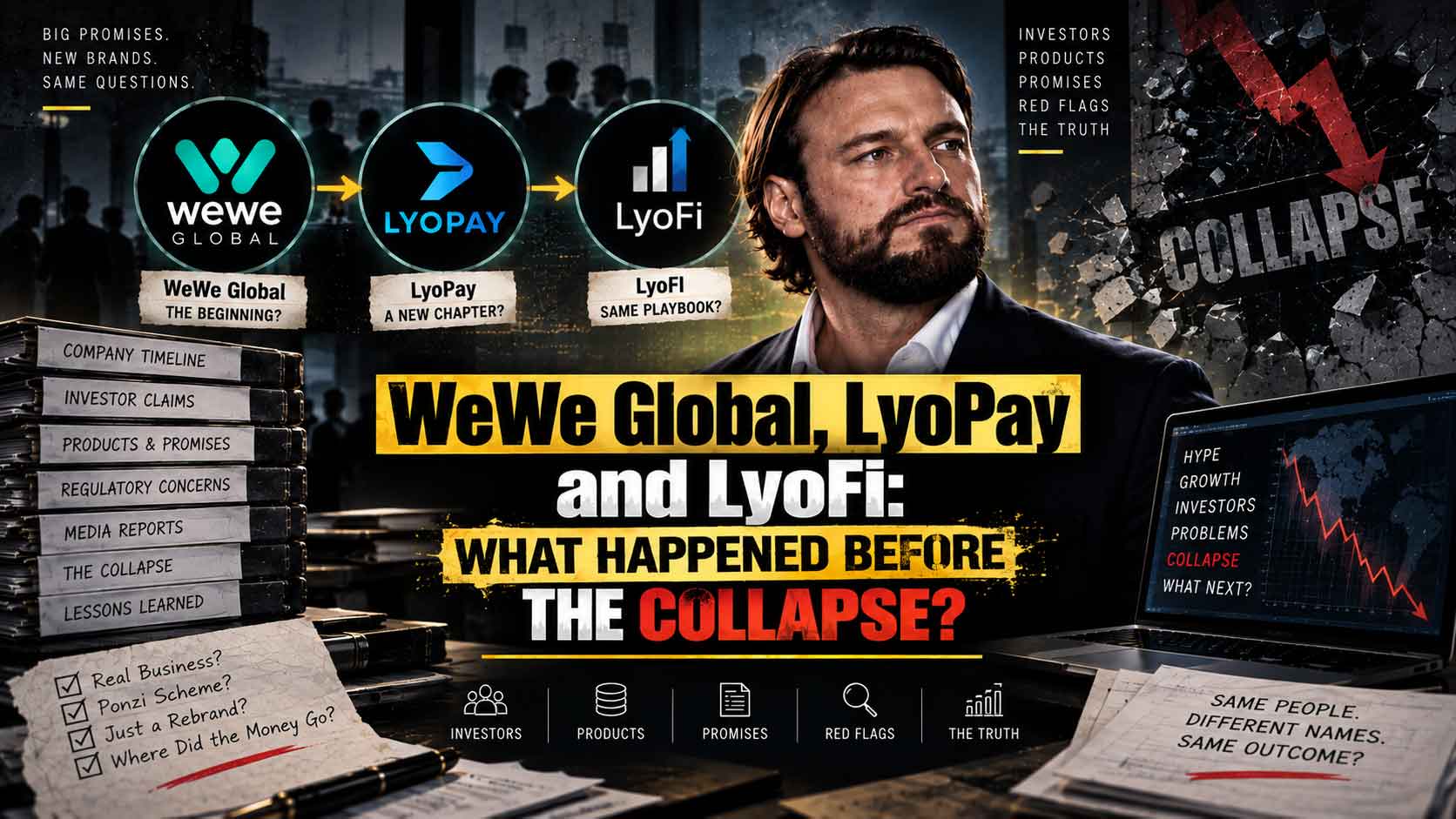
WeWe Global emerged around 2021 and initially operated around the WEWEX token and an MLM-style structure. After the first model collapsed, LyoFI and LyoPay appeared as part of what BehindMLM described as a reboot of the WeWe Global ecosystem. LyoPay was fronted publicly by Luiz Goes, who was presented as its CEO.
The LYO token became central to the next phase. LyoFI promoted investment plans and advertised returns, with BehindMLM reporting that the model promoted up to 300 percent ROI over 900 days.
When that version ran into problems, LFI followed.
Then came The Blockchain Era. The Blockchain Era did not simply appear in a vacuum. BehindMLM described it as another reboot of the WeWe Global operation, with LyoTrade and LyoWallet appearing within the same broader ecosystem.
The project eventually collapsed and was followed by Xera.
Xera then became another subject of regulatory concern. In April 2024, Australia’s ASIC warned that Xera was likely offering financial services to Australian consumers without an Australian financial services or credit licence.
And the story did not stop there. Reporting on the broader ecosystem later described another transition from Xera to Homnifi. ASIC subsequently added WeWe Global to its Investor Alert List in April 2025, stating that it was likely offering financial services to Australian consumers without the required Australian licence or authorisation.
New Zealand’s Financial Markets Authority had already issued a warning in February 2023 concerning WEWE Global and LYOPAY, later updating it in November 2023 to identify The Blockchain Era as an alias. The FMA said the entities were offering cryptocurrency products and services in New Zealand without being registered or regulated for New Zealand retail clients.
So when I look at the history, I do not see one isolated failed cryptocurrency company.
I see a sequence of projects that deserve to be examined together.
But where does Vinassa actually fit?
This is where things become much more difficult, and this is also where a responsible investigation needs to be careful.
There are people who have directly alleged that Vinassa was more deeply involved in the WeWe Global ecosystem than his current public profile suggests.
The most significant public allegation came from Luiz Goes. Goes was not some random person commenting on a forum. He was publicly associated with the ecosystem, presented himself as CEO of LyoPay and appeared in WeWe Global marketing presentations. BehindMLM reported that Goes later alleged that Vinassa was the owner of WeWe Global, VAI Marketing Management and a majority shareholder of VAI Marketing. BehindMLM said Goes supplied a Dubai company registration in support of the ownership allegation.
That is an allegation backed, according to the publication, by a corporate document provided by a former executive.
But it is still important not to turn that into a fact that the available evidence does not independently establish.
BehindMLM itself said it could not independently confirm who actually ran WeWe Global.
That leaves a genuine investigative question.
If Vinassa was not involved in the management or ownership of these companies, why did people inside the ecosystem repeatedly connect his name to them?
If the allegations are accurate, what was his exact role?
Was he an owner, investor, adviser, promoter, shareholder, beneficial controller or something else?
And if the answer is none of those things, where is the documentation that clearly establishes the distinction?
Those are questions that corporate records can potentially answer much better than promotional interviews.
The people around the projects matter too
One of the things that becomes obvious when researching the history is that the same names and companies keep coming back.
Luiz Goes is an obvious example. He appeared publicly around LyoPay and WeWe Global and later became associated with The Blockchain Era. BehindMLM documented his public role across several stages of the ecosystem.
There were other executives, promoters and companies around the various projects as well.
This matters because a company’s branding can change much faster than its underlying network. A new logo can be created overnight. A new website can be launched. A new token can be issued. A new company name can appear.
The people behind the operation are much harder to change.
That is why looking at corporate connections, directors, shareholders, domains, wallets, executives and previous business relationships can sometimes tell you more than the latest company website.
The regulatory record is a separate issue
There is another distinction that should be made very clearly.
A regulatory warning about a company does not prove that Vinassa personally committed wrongdoing.
The New Zealand FMA warning concerned WEWE Global, The Blockchain Era and LYOPAY. The Australian warnings concerned entities including Xera and later WeWe Global.
Those warnings are important because they establish that regulators had concerns about specific businesses and their activities.
They do not, by themselves, establish who secretly controlled those businesses.
That is why I find the corporate question more interesting than simply repeating the word “scam” over and over.
The real investigation is about ownership, control, money and continuity.
Who created the companies?
Who owned them?
Who received the money?
Who controlled the technology?
Who controlled the marketing?
Who appeared publicly?
Who disappeared when things went wrong?
And who appeared again when the next project launched?
Those questions can potentially connect the dots without relying on speculation.
The biggest contrast is in the language
What strikes me most when comparing the current PR material with the older business history is not necessarily one particular statement.
It is the language.
The current material talks about innovation, leadership, AI, strategic patience, long-term thinking, technology investment and building ecosystems.
The older material around the cryptocurrency projects talks about tokens, recruitment, investment packages, commissions, returns, trading platforms and repeated project launches.
Those are two very different narratives around the same individual.
Of course, people evolve. Someone involved in cryptocurrency several years ago can later become an AI investor. Someone can make mistakes, learn from them and build something entirely different. A failed business does not automatically define everything that person does afterward.
But when the older history includes serious allegations and regulatory warnings, a reader deserves to know that history before forming an opinion about the newer image.
That is the part I think is missing from much of the current PR narrative.
The role of paid PR
There is another layer to this.
I have reviewed a large collection of articles presenting Vinassa in a positive light, covering subjects ranging from AI and entrepreneurship to leadership and technology investment. I have evidence that the PR material I reviewed includes paid or sponsored placements.
That does not mean every statement in those articles is false. It means the reader needs to understand what kind of media they are looking at.
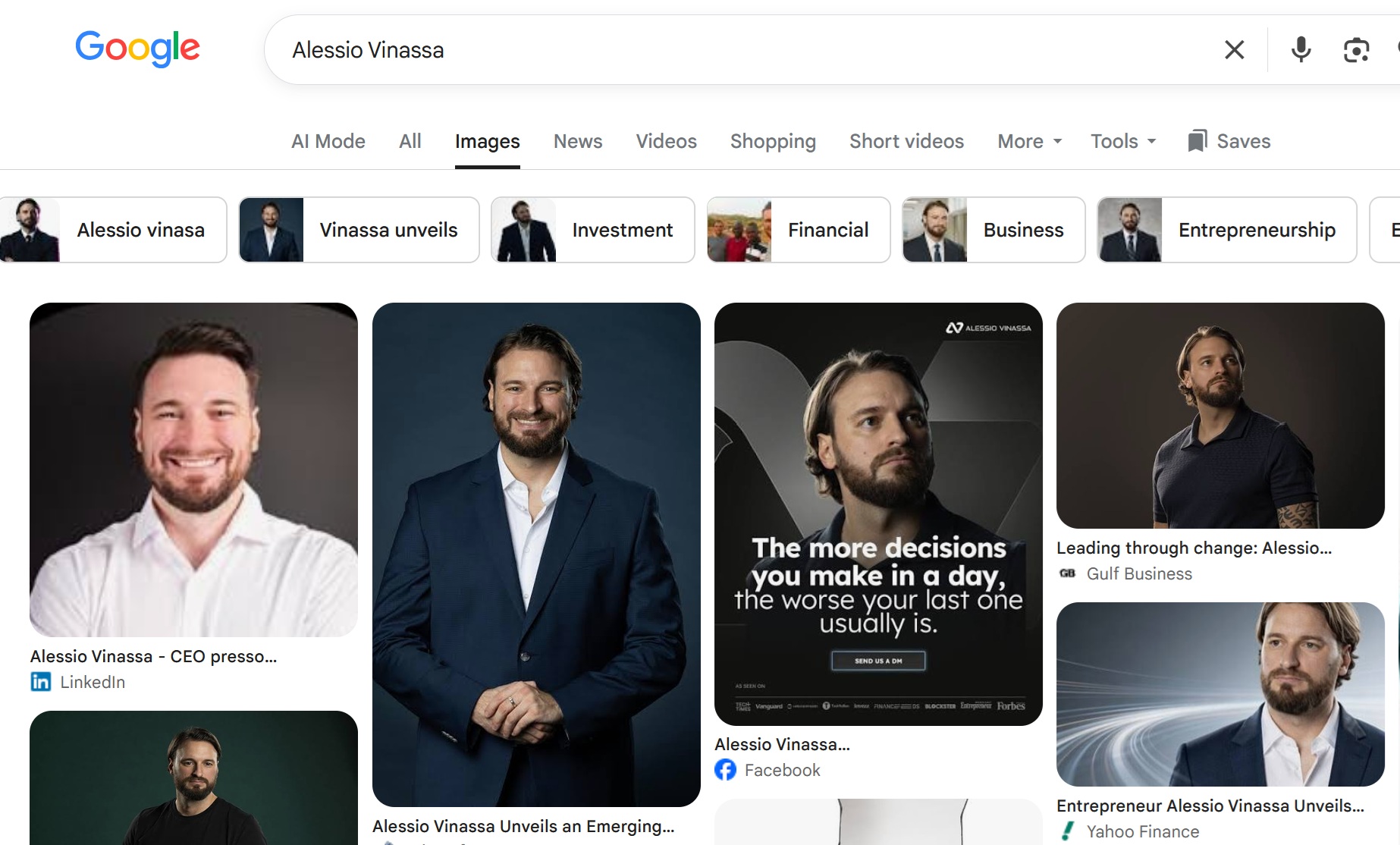
There is a major difference between an investigative reporter independently deciding to investigate an entrepreneur and a sponsored article designed to publish that entrepreneur’s message.
Both can appear on well-known websites.
Both can look professional.
Both can rank in Google.
But they serve different purposes.
When dozens of positive articles repeat similar descriptions of a person, the cumulative effect can be powerful. Someone searching the person’s name may encounter a consistent story about entrepreneurship, technology, leadership and innovation without necessarily seeing the older controversies.
That is not proof that someone deliberately manipulated search results.
It is simply how online reputation works.
The more positive material exists around a name, the harder it can become for older material to remain visible.
And if older critical articles disappear at the same time, the effect becomes even more significant.
What happens when the negative history disappears?
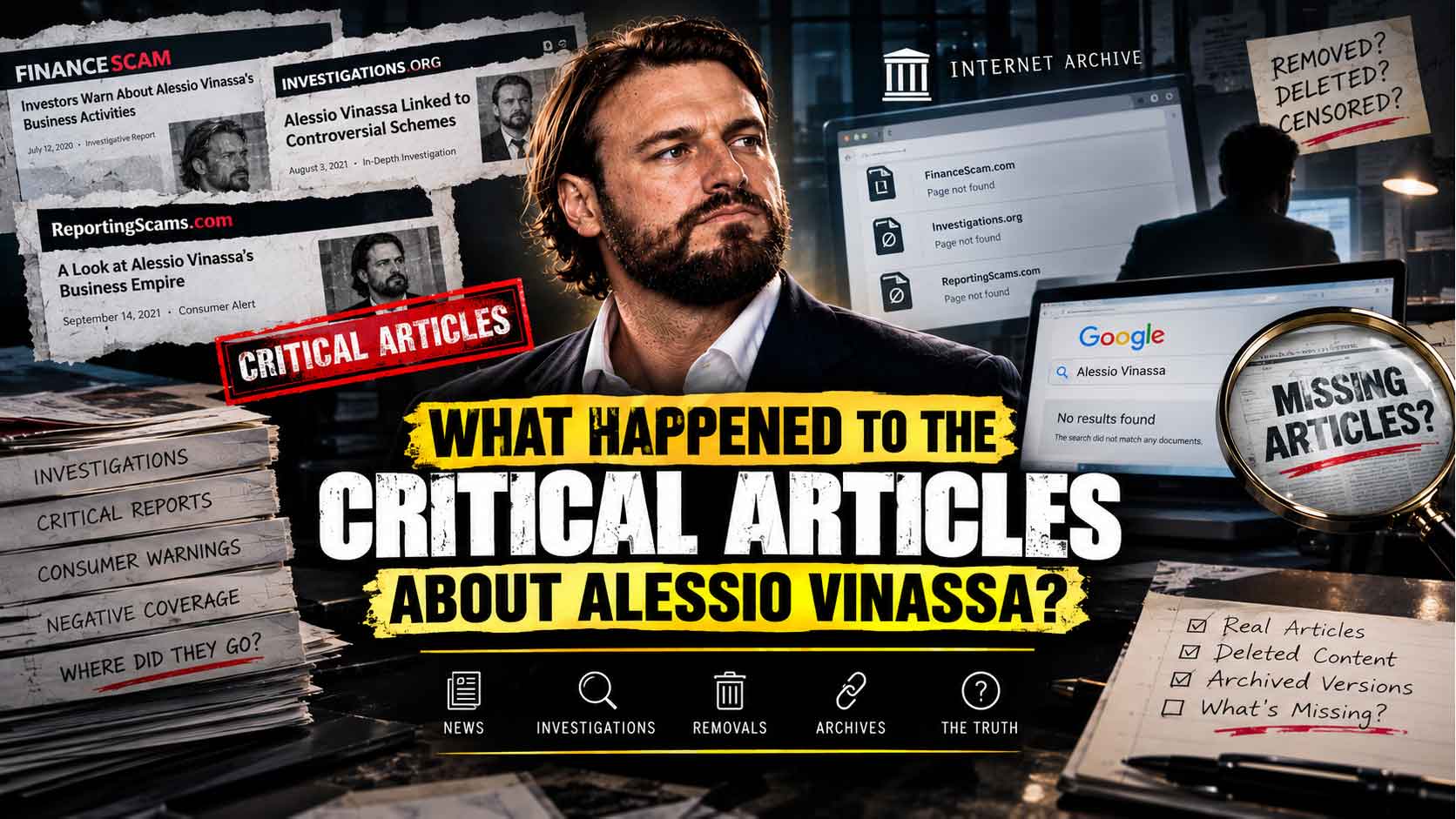
This is an area I am investigating separately because there are specific examples where articles that once existed are no longer available.
One example is ReportingScams.com.
An article titled Alessio Vinassa: What Prospective Investors Should Know Before Investing previously discussed the allegations and controversies surrounding Vinassa and the companies connected to his name. The article specifically mentioned Lira Coin, WeWe Global, LyoPay, LFI, XERA and The Blockchain Era, while making clear that allegations about Vinassa’s role were disputed and not established in court.
The article also discussed investor complaints, regulatory attention and Luiz Goes’ allegations concerning Vinassa.
That page is no longer publicly available at its original location.
https://www.reportingscams.com/alessio-vinassa-what-prospective-investors-should-know-before-investing [ Deleted Now]
I have evidence concerning the circumstances surrounding its removal. I am not going to turn that evidence into a conclusion without documenting it properly, because the question of how critical coverage disappears is itself something that deserves evidence.
The same approach applies to other websites that previously carried critical reporting about Vinassa.
If articles were voluntarily removed, there should be a reason and i.e either legal threat or money is involved.
The two versions of the story
This is ultimately why I think the PR persona versus company history comparison matters.
The current Vinassa profile is built around technology, investment, AI, cybersecurity and leadership. BlockTech’s own biography describes him in those terms and presents him as someone focused on emerging technology and long-term value.
The older public record contains a different collection of names.
WeWe Global | LyoFI | LyoPay | LFI | The Blockchain Era | Xera | Homnifi.
There are documented regulatory warnings involving parts of that broader ecosystem. There are investigative reports describing the relationship between several of the projects. There are allegations from former participants and executives about who controlled the operation. And there are still unanswered questions about the precise relationship between Vinassa and those companies.
That does not mean every allegation is true.
It does mean the history deserves to be part of the conversation.
A person’s current biography should not erase their previous business history, just as their previous business history should not automatically determine whether everything they do today is legitimate.
Both parts of the story need to be examined.
That is the difference between researching a person and simply searching for a flattering biography.
For me, the central question is not whether Alessio Vinassa can reinvent himself. Of course he can. Anyone can change industries, launch new companies and build a new professional identity.
The question is whether the public has been given the full history needed to understand that reinvention.
Because when you put the PR persona next to the company history, there is a gap.
And that gap is where the investigation begins.