
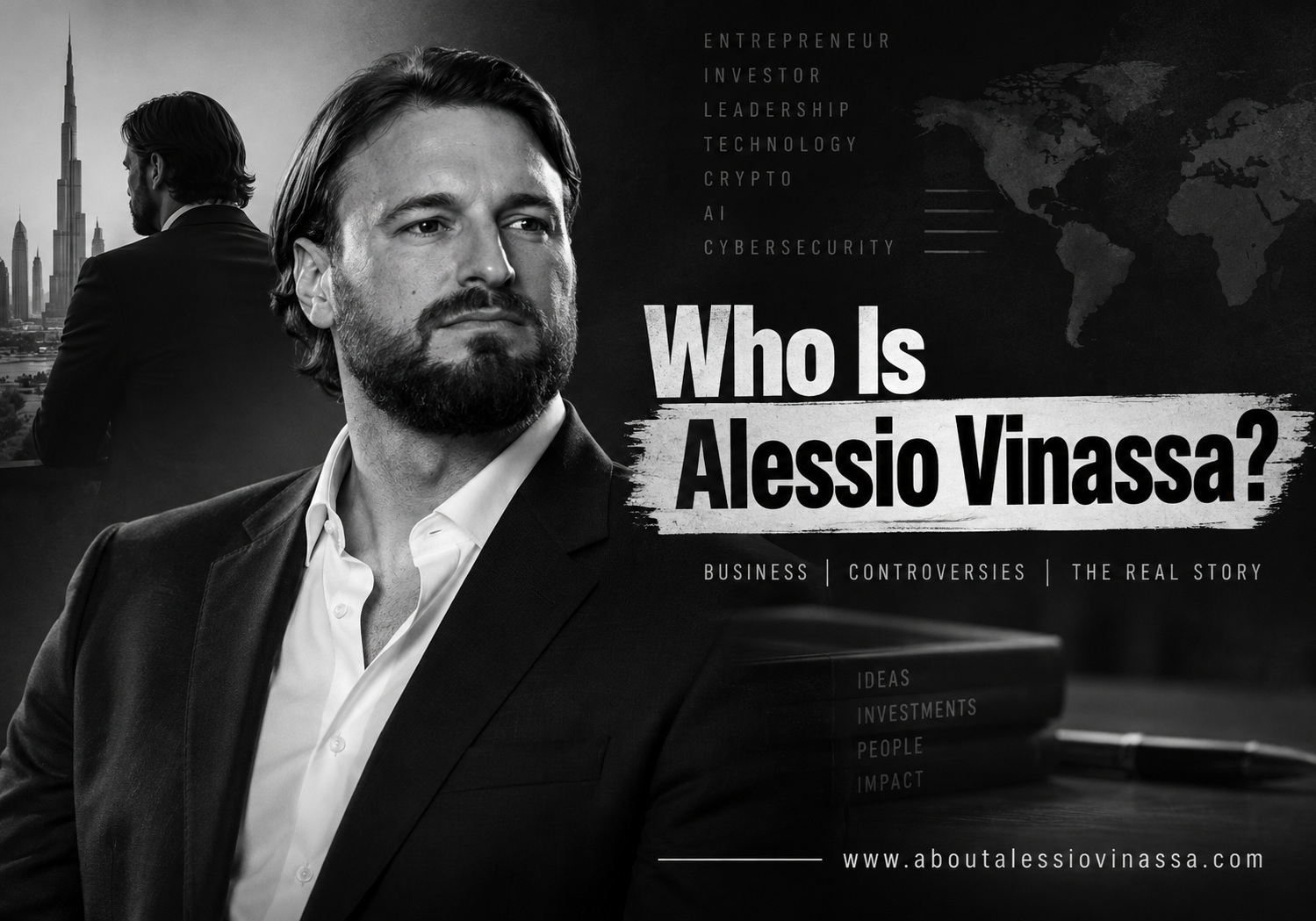
Who Is Alessio Vinassa?
I did not start looking into Alessio Vinassa because I was interested in writing another article about a Dubai-based entrepreneur, a crypto investor or someone presenting himself as a technology leader. I started looking into him because his name kept appearing around companies and projects that raised serious questions, and eventually those questions became personal for me.
The more I looked, the harder it became to separate the public image from the older history surrounding the businesses connected to his name. Today, Vinassa is presented online as an entrepreneur, angel investor, technology builder and author with more than 15 years of experience across cybersecurity, artificial intelligence, Web3 and innovative finance. His current profile is built around BlockTech Group, technology investment, leadership and his book No One Is Coming: The Mental Operating System for Leaders Under Pressure. He has also claimed to have backed more than 40 ventures.
Those are significant claims. But when you start looking at the older trail rather than the current profile, a very different set of questions comes up. This article is my attempt to put that history together in one place.
It is important to say at the beginning that not every allegation made about Vinassa has been independently proven. Some information comes from regulatory warnings, some from investigative publications, some from former participants or executives, and some from people posting anonymously online. There are also claims that Vinassa has disputed. I am separating those things because there is a difference between something documented by a regulator, an allegation made by a former executive and something written by an anonymous commenter on the internet.
That distinction matters.
The Public Image of Alessio
If you search for Alessio Vinassa today, the picture is fairly straightforward. You will find interviews and articles describing him as an entrepreneur, investor and technology leader. His current messaging focuses heavily on artificial intelligence, cybersecurity, blockchain, Web3, innovation and leadership.
He talks about helping founders and executives make decisions under pressure. He describes himself as someone who has spent years working across technology and investment. His public material increasingly positions him as someone interested in long-term innovation rather than simply cryptocurrency.
There is nothing unusual about an entrepreneur changing direction as his career develops. Technology changes quickly, companies fail, people move into different industries and investors regularly reinvent themselves.
The problem, at least from my perspective, is that the older history does not simply disappear because the newer biography sounds different.
Before the current focus on AI, leadership and technology investment, Vinassa’s name appeared in discussions around a number of cryptocurrency and MLM-style projects, including Lira Coin Club, WeWe Global, LyoFI, LyoPay, LFI, The Blockchain Era and later Xera and Homnifi.
The question I kept coming back to was simple. How much of this history is actually connected to Vinassa, and how much of it has simply been attached to his name by critics?
That is where the research becomes much more complicated.
The Lira Coin connection
One of the earliest names that comes up in this history is Lira Coin Club.
In 2019, BehindMLM published an investigation describing Lira Coin Club as a token-lending and mining-return scheme. According to the publication, participants were encouraged to invest in LIC tokens and lend them back in exchange for advertised monthly returns. The company also promoted mining packages and operated an MLM compensation structure.
The same investigation reported that Italy’s financial regulator, CONSOB, temporarily suspended promotion of LiraCoin Club in June 2019 over concerns relating to investment fraud.
That regulatory action is a matter that can be documented independently. What is much harder to establish is exactly who controlled the operation.
Comments beneath the BehindMLM investigation accused Alessio Vinassa of being the real owner or promoter of Lira Coin Club. Other commenters connected Vinassa with people such as Diego Endrizzi and Paolo deVita and alleged that the project later evolved or moved into other ventures.
Those comments are not proof of ownership. They are allegations posted by individuals whose identities and evidence are not necessarily established.
Still, they are interesting when viewed alongside what happened later.
Because the next part of the story was WeWe Global.
WeWe Global, LyoFI and LyoPay
WeWe Global began attracting attention around 2021. It promoted cryptocurrency-related products and a large recruitment network, and its ecosystem eventually became associated with LyoFI and LyoPay.
BehindMLM’s reporting provides a fairly detailed chronology of what followed. WeWe Global went through multiple iterations, with the WEWEX model eventually collapsing. LyoFI and LyoPay then became prominent parts of the ecosystem, with the LYO token being promoted as an investment opportunity.
LyoFI advertised returns of up to 300 percent over 900 days, according to BehindMLM. The system included investment plans ranging from €100 to €100,000, with returns distributed through LYO tokens.
Luiz Goes became one of the most visible people in that operation. He was presented as CEO of LyoPay and appeared in WeWe Global presentations and events.
Goes later made much more serious claims about who was actually behind the operation.
In a later clarification reported by BehindMLM, Goes alleged that Alessio Vinassa was the owner of WeWe Global and VAI Marketing Management and that Vinassa was a majority shareholder of VAI Marketing. BehindMLM said the ownership claim was based on a Dubai company registration provided by Goes.
Goes also alleged that Vinassa and another person named Diego were the real controllers behind the operation while the public-facing executives played other roles.
This is one of the most important claims in the entire story, but it needs to be handled carefully. BehindMLM itself stated that it had not independently confirmed who actually ran WeWe Global. The publication reported Goes’ allegations and the corporate document he provided, but that is not the same thing as an independently established finding that Vinassa controlled WeWe Global.
That distinction is important enough to repeat.
What is not particularly difficult to establish is that the companies and people around the WeWe Global ecosystem kept appearing together as the operation changed form.
When LYO began collapsing, another project appeared.
LFI.
The Projects Kept Changing Names
The LYO token eventually ran into serious problems. In early 2023, WeWe Global launched LFI, or L-Finance, as another iteration of the ecosystem. BehindMLM reported that LFI offered a BEP-20 token and advertised extremely high annual returns. Participants could invest directly or convert LYO into LFI, with the new structure effectively extending the life of the previous system.
Then came The Blockchain Era.
The Blockchain Era was presented as a new project, but BehindMLM described it as another reboot of the WeWe Global ecosystem. It featured LyoTrade and LyoWallet and promoted tokens including EURfi and XLFi. It also marketed an AI trading-bot concept under the Quantwise name.
The investment packages were substantial, ranging from around €110 to more than €1 million.
The compensation structure was built around recruitment and multiple levels of commissions, according to BehindMLM’s reporting.
In November 2023, New Zealand’s Financial Markets Authority issued a warning concerning WEWE Global, The Blockchain Era and LYOPAY. The FMA said the entities were offering cryptocurrency products or services to New Zealand consumers through webinars and events without being registered or regulated for New Zealand retail clients.
That is different from an anonymous internet allegation. It is a regulatory warning and should be treated as such.
The Blockchain Era eventually collapsed as well.
Then came Xera.
BehindMLM reported that Xera was announced in Dubai in January 2024 as a combination of Safir International, Success Factory and The Blockchain Era. It promoted investment packages, tokens, AI trading products and a multi-level compensation structure.
In April 2024, Australia’s ASIC added Xera to its Investor Alert List, stating that Xera appeared to be offering financial services to Australian consumers without the required Australian financial services or credit licence.
Again, the regulatory record is separate from the question of who actually controlled these businesses.
But the repeated sequence is difficult to ignore.
One project appears, attracts investors and promoters, runs into trouble, and another project emerges around much of the same network.
WeWe Global | LyoFI | LyoPay | LFI | The Blockchain Era | Xera | Homnifi.
That chronology is one of the reasons I believe the history deserves to be examined rather than buried underneath a newer entrepreneurial biography.
Where does Vinassa fit into all of this?
This is probably the most difficult part of the story. There is plenty of material online connecting Vinassa to the broader ecosystem, but not every piece of that material proves the same thing.
Some people have accused him of being the person behind these companies. Luiz Goes has made direct allegations about Vinassa’s role. BehindMLM later published those allegations and said Goes provided a Dubai company registration supporting his claim about VAI Marketing.
There are also anonymous comments from people claiming to have worked inside parts of the ecosystem. One commenter identifying themselves as a software developer claimed that Vinassa was the real founder behind projects including The Blockchain Era, Xera and Lyo, while the public executives were merely marketing faces.
That is an allegation from an anonymous source. It cannot be treated as independently verified evidence.
But there is another reason these claims continue to attract attention. Vinassa’s name does not appear only once in relation to these projects. It appears repeatedly across discussions about several different iterations of the same broader ecosystem.
At some point, the question stops being whether one particular anonymous comment is credible and becomes a much broader question about the corporate and personal relationships connecting these companies.
That is what I think deserves more investigation.
The regulatory trail is harder to dismiss
Even if we put aside the arguments over who owned what, there is a documented regulatory history surrounding several of the companies.
New Zealand’s Financial Markets Authority warned about WeWe Global, The Blockchain Era and LYOPAY.
Australia’s ASIC later placed WeWe Global on its Investor Alert List and said it appeared to be offering financial services to Australian consumers without the appropriate Australian licence or authorisation.
ASIC’s warning does not establish that Vinassa personally controlled WeWe Global. The FMA warning does not establish that either.
But these warnings do establish something important about the environment in which these businesses operated.
They were not simply obscure technology startups that received criticism from a few people online. Regulators in different countries publicly raised concerns about entities associated with the ecosystem.
That is a part of the history that cannot simply be replaced with a new biography.
The Reinvention
What is particularly interesting to me is what happened to Vinassa’s public positioning as the older crypto projects disappeared.
The language changed.
The focus moved toward AI, cybersecurity, Web3 infrastructure, technology investment, leadership and innovation. The newer articles present a much more conventional entrepreneurial story. Instead of being associated primarily with crypto investment programs and MLM-style ecosystems, Vinassa is increasingly described as a technology investor and thought leader.
His current public profile also includes BlockTech Group and a book about leadership under pressure.
Again, there is nothing inherently suspicious about changing industries or rebuilding a professional reputation. People do it all the time.
But when the earlier history involves serious allegations and regulatory warnings, I think readers have a legitimate reason to ask about the transition.
What happened to the companies that came before?
Who actually owned them?
Who controlled the money?
Who benefited?
What happened to the people who invested?
And why did the same network of people and companies appear repeatedly as one project gave way to another?
Those are much more interesting questions than simply asking whether someone is a successful entrepreneur.
The Paid PR machine to White Wash the Image.
Another part of this story is the volume of positive media surrounding Vinassa.
Over time, his name has appeared in publications discussing AI, blockchain, leadership, investment, innovation, entrepreneurship and the future of technology. Some of the newer articles focus on his views about decision-making, adaptability, financial challenges and building technology businesses.
I have reviewed a large number of these articles as part of this investigation. I have also been provided evidence that some of the articles were paid or sponsored placements rather than independent editorial investigations.
That distinction matters.
A sponsored article can still contain accurate information. Paying for publication does not automatically make every statement in an article false. But readers should know whether they are reading independent journalism or promotional material.
The difference becomes particularly important when the promotional material presents a clean entrepreneurial narrative while leaving out the controversies surrounding earlier businesses.
That is where reputation management becomes interesting.
You do not necessarily need to erase every negative story from the internet if you can fill the search results with enough newer, positive material.
A person searching for Vinassa today may see articles about AI, entrepreneurship, leadership and innovation before encountering older investigations into cryptocurrency projects.
That does not prove that Vinassa personally engineered the entire media strategy. It does, however, show how dramatically a public profile can change when large volumes of positive content begin appearing around the same name.
What happened to the Expose Article?
This is another part of my investigation that I am still documenting.
Several websites that previously carried critical material about Vinassa have had pages disappear or become inaccessible. That includes material associated with Investigations.org, ReportingScams.com and FinanceScam.com.
https://www.financescam.com/alessio-vinassa [ Deleted ]
https://www.reportingscams.com/alessio-vinassa-what-prospective-investors-should-know-before-investing/ [ Deleted ]
In the case of ReportingScams.com, I have the original article that was previously published under the title Alessio Vinassa: What Prospective Investors Should Know Before Investing. The article discussed the allegations surrounding Lira Coin, WeWe Global, LyoPay, LFI and XERA and specifically identified Luiz Goes’ allegations while noting that they were disputed and not established in court.
The article also described Vinassa as being associated in public reporting with several cryptocurrency ventures and discussed regulatory concerns and investor complaints surrounding the ecosystem.
That article is no longer publicly available at the URL where it was originally published.
I have my own evidence regarding what happened to that article and the circumstances surrounding its removal. I will deal with that separately rather than mixing it into this article without documenting the evidence.
The same applies to other publications.
If critical articles disappear while a large volume of new promotional content appears, it is reasonable to investigate the full history rather than looking only at the current search results.
That is what I am doing.
So Who is Alessio Vinassa?
After going through the available material, I do not think there is a responsible way to reduce Alessio Vinassa to either a clean entrepreneurial success story or a collection of accusations from people on the internet.
The public record is more complicated than that.
There is a current profile presenting him as an entrepreneur, investor and technology leader. There is a history involving cryptocurrency and MLM-style projects that repeatedly changed names and structures. There are regulatory warnings involving several entities in that broader ecosystem. There are allegations from Luiz Goes about Vinassa’s role and corporate ownership. There are anonymous allegations from people claiming inside knowledge. There are critical investigations from publications such as BehindMLM and other outlets.
And there are large gaps in the public record that still need answers.
The biggest unanswered question is not whether Vinassa has written about AI or leadership. He clearly has.
The bigger question is how much responsibility, ownership or control he had over the businesses that came before the current BlockTech and technology-investor image.
That question cannot be answered simply by reading a biography on a company website or a sponsored interview.
It requires corporate records, ownership documents, financial trails, regulatory filings, statements from former executives and investors, archived websites and, where possible, direct responses from the people involved.
That is the direction I intend to take this investigation.
I am not interested in creating another internet hit piece, and I am not interested in repeating allegations simply because somebody posted them online. I have been personally affected by this story, which is exactly why I think the evidence needs to be handled carefully.
There is already enough material to ask serious questions.
The next step is finding the answers.