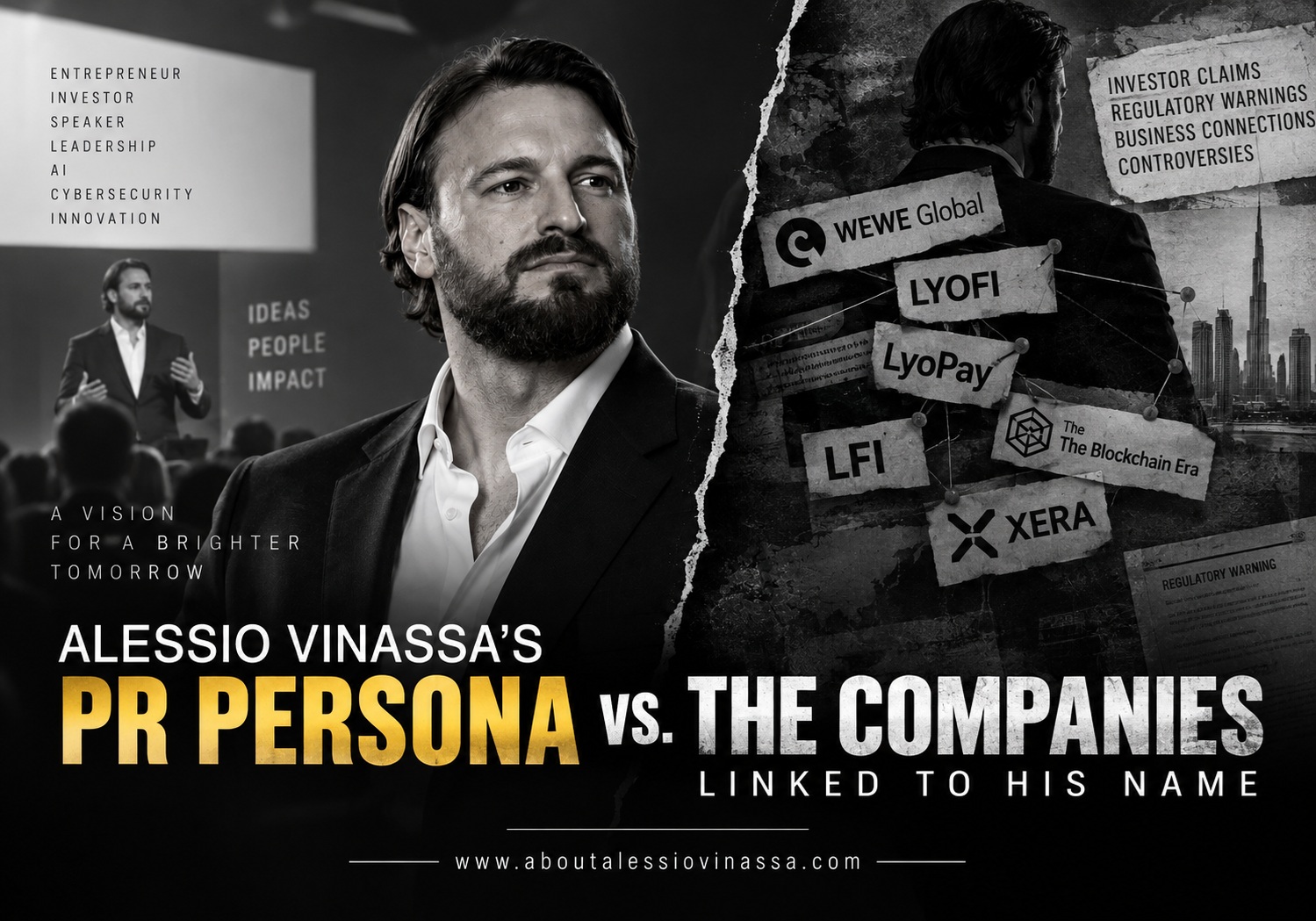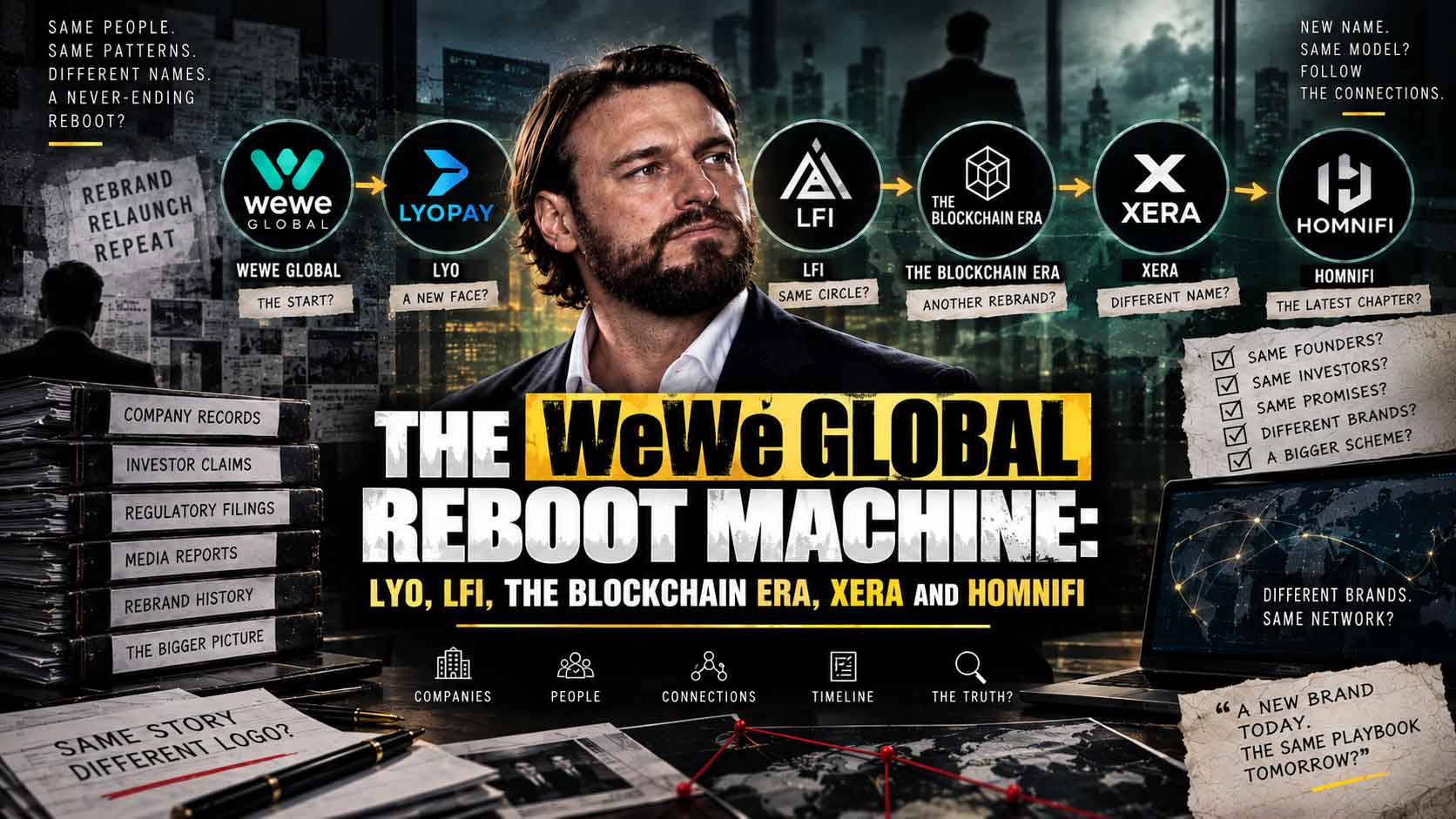
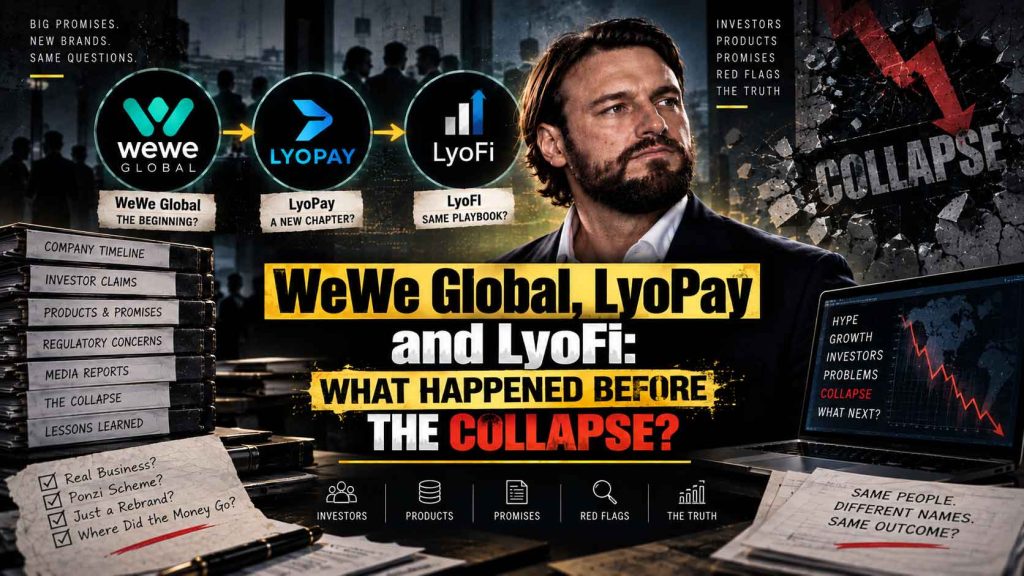
When people talk about the controversy surrounding Alessio Vinassa, WeWe Global is one of the names that comes up repeatedly. But before getting into the question of Vinassa’s alleged role, it is worth understanding what actually happened inside the WeWe Global ecosystem.
The story was not simply about one website disappearing and another appearing. WeWe Global went through several different versions, with new tokens, new companies and new investment models introduced as earlier versions ran into trouble.
The most important transition was from WEWEX to LyoFI and LyoPay.
And that is where the story became much bigger.
The first WeWe Global model
WeWe Global emerged in 2021 around a cryptocurrency-based MLM model. BehindMLM‘s original investigation described the first version as being built around WEWEX tokens and a recruitment structure. The project also promoted travel-related benefits, but the investment side was central to its appeal.
The WEWEX model eventually collapsed.
Instead of the story ending there, a new structure appeared.
LyoFI.
The LyoFI domain was privately registered in July 2021, and WeWe Global announced LyoFI as a partnership in October of the same year. BehindMLM reported that LyoFI’s website listed DigiFi Group Ltd, a British Virgin Islands company, while WeWe Global was associated with DigiTech Services Ltd. LyoPay was separately connected to DigiLYO App Ltd.
Those corporate connections became an important part of the story because the new companies were not operating independently from the WeWe Global ecosystem. LyoFI and LyoPay became the infrastructure around the next version of the business.
LyoFI and the LYO token
The new model revolved around LYO.
LyoFI promoted what it called “cloud minting”, with participants putting money into LYO-related investment plans. BehindMLM reported that the plans ranged from €100 to €100,000 and advertised a return of up to 300 percent over 900 days. Participants received returns in LYO tokens, which could then be converted into Bitcoin.
That sounds very different from the original WEWEX model on the surface.
Underneath, however, the basic investment proposition remained remarkably similar.
People were putting money into a cryptocurrency-based system with the expectation of receiving more value later.
The problem was that the token itself needed a functioning market and sufficient liquidity for those returns to become real money outside the system.
That became increasingly difficult as the LYO token lost value.
By January 2023, BehindMLM reported that LYO was collapsing and that WeWe Global had moved on to another token, LFI.
Where LyoPay fits in
LyoPay was another important part of this structure.
The company described itself as a cryptocurrency exchange and was publicly associated with Luiz Goes, who presented himself as its CEO. BehindMLM reported that LyoPay had launched in 2020 but had been largely inactive before its involvement with WeWe Global became more visible.
Goes was not simply a name appearing on a company website.
He became one of the public faces of the operation.
He appeared in WeWe Global marketing presentations and promoted the ecosystem publicly. BehindMLM documented him presenting WeWe Global opportunities while simultaneously being identified as LyoPay’s CEO.
This created an obvious question about how separate WeWe Global and LyoPay really were.
If LyoPay was simply a technology provider or business partner, why was its CEO so deeply involved in WeWe Global’s marketing?
And if the two businesses were more closely connected, who actually controlled the overall operation?
Those questions became even more important later.
The Dubai connection
A significant part of the operation was based around Dubai.
WeWe Global’s social media presence was reported as being managed from the UAE and Italy, while Goes was publicly operating from Dubai. BehindMLM’s reporting connected the LyoFI and LyoPay structure to Dubai and noted the overlap between the companies and their corporate entities.
Dubai itself is not evidence of wrongdoing. There are thousands of legitimate technology and cryptocurrency companies operating in the UAE.
The relevant issue here is the combination of location, corporate structure, public executives and the repeated appearance of the same network as the projects evolved.
The more complicated the structure became, the harder it was for an outside investor to understand who was actually behind the businesses.
Then came the regulator
The concerns were not limited to independent investigators.
New Zealand’s Financial Markets Authority issued a warning about WeWe Global and LYOPAY in February 2023 and updated the warning in November 2023. The FMA said WeWe Global, also known as The Blockchain Era, and LYOPAY were offering cryptocurrency products and services through webinars and public events in New Zealand while not being registered or regulated to provide those services to New Zealand retail clients.
The FMA specifically described the entities in its warning as a suspected Ponzi and pyramid scheme.
That is a regulator’s characterization of the entities and activities it was warning about. It does not establish that every person associated with those companies committed an offence.
But it does establish that the business had attracted regulatory concern.
And by then, the LYO model was already falling apart.
The LYO collapse
By the beginning of 2023, the LYO token was losing value and the WeWe Global ecosystem needed another solution.
The answer was LFI.
BehindMLM reported in January 2023 that WeWe Global had launched L-Finance after the LYO collapse. The new LFI token offered advertised annual returns as high as 2,857.14 percent, according to the publication. Participants could invest in LFI or convert their LYO holdings into LFI.
This is where the broader pattern becomes difficult to overlook.
WEWEX had come first.
Then LFI.
Each new structure gave participants another token or mechanism through which the ecosystem could continue.
By August 2023, BehindMLM reported that WeWe Global had suspended withdrawals and that investors were unable to cash out LFI into Bitcoin. Instead, they were directed toward converting their holdings into another internal asset that had to be reinvested. The publication described this as the third collapse of WeWe Global.
In September 2023, the next version appeared.
The Blockchain Era.
The WeWe Global name had effectively become associated with several failed iterations, and the operation moved forward under a different identity. BehindMLM described The Blockchain Era as the fourth reboot of the WeWe Global ecosystem.
And where does Vinassa come in?
This is where the story returns to Alessio Vinassa.
The early reporting around WeWe Global focused heavily on Luiz Goes and other people publicly involved with the companies. In fact, BehindMLM initially said it believed Goes might be behind WeWe Global because of his position, his involvement in the marketing and his connection to the underlying technology.
That changed years later.
In 2025, Goes made a direct allegation that Vinassa was the person behind WeWe Global and its successor operations. BehindMLM reported that Goes claimed Vinassa owned WeWe Global and VAI Marketing Management and was a majority shareholder of VAI Marketing. Goes reportedly provided a Dubai company registration to support his claim.
Those allegations deserve investigation, but they should not be presented as established fact without independent confirmation.
What can be established is the sequence.
The WEWEX model collapsed.
LyoFI and LyoPay became central to the next version.
The LYO token was promoted with substantial advertised returns.
LYO collapsed.
LFI followed.
That collapsed as well.
Then came The Blockchain Era, followed later by Xera.
The regulatory record also followed the ecosystem.
For me, this is why the WeWe Global chapter matters so much when examining Vinassa’s current public image. The question is not simply whether his name appeared somewhere on an old website.
The question is who was behind the structure, who controlled the companies, and whether the same people remained involved as one project was replaced by another. That is the part of the story that still needs to be fully answered.