When you investigate someone who has been online for years, you normally expect the internet to give you too much information.
With Alessio Vinassa, I found the opposite problem.
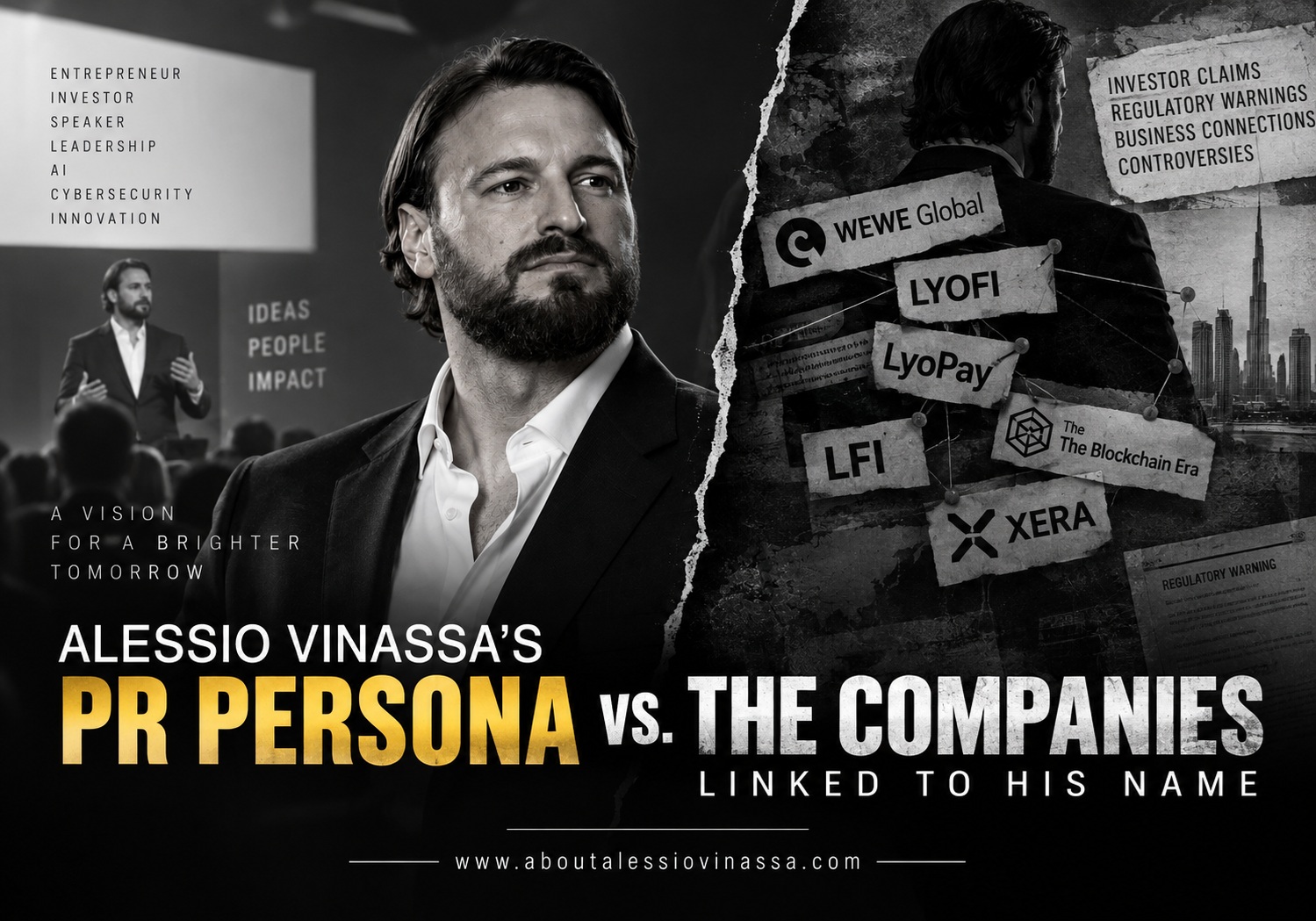
There is plenty of information about him today. There are interviews, profiles, promotional articles and business biographies describing him as an entrepreneur, investor, technology builder and thought leader. There is material about AI, cybersecurity, Web3, leadership and emerging technology.
But when you start looking for some of the older critical material, the record becomes much less complete.
Pages that once existed are no longer available. Some publications have disappeared or changed. Other articles survive only through references in newer investigations.
That creates a strange situation. The internet can give you a very detailed picture of who someone wants to be seen as today while making it surprisingly difficult to reconstruct what was being written about that person several years earlier.
That is why I started rebuilding the history from what remains.
Starting with what can still be found
One of the most useful surviving sources is BehindMLM.
https://behindmlm.com/companies/luiz-goes-claims-alessio-vinassa-ran-wewe-global-ponzi/
https://behindmlm.com/mlm-reviews/lira-coin-club-review-lic-token-lending-ponzi-scheme/
https://behindmlm.com/companies/the-blockchain-era-ponzi-pyramid-warning-from-new-zealand/
https://behindmlm.com/companies/wewe-global-securities-fraud-warning-from-australia/
https://behindmlm.com/companies/the-blockchain-era-securities-fraud-warning-from-australia/
https://behindmlm.com/mlm-reviews/the-blockchain-era-fourth-wewe-global-ponzi-reboot/
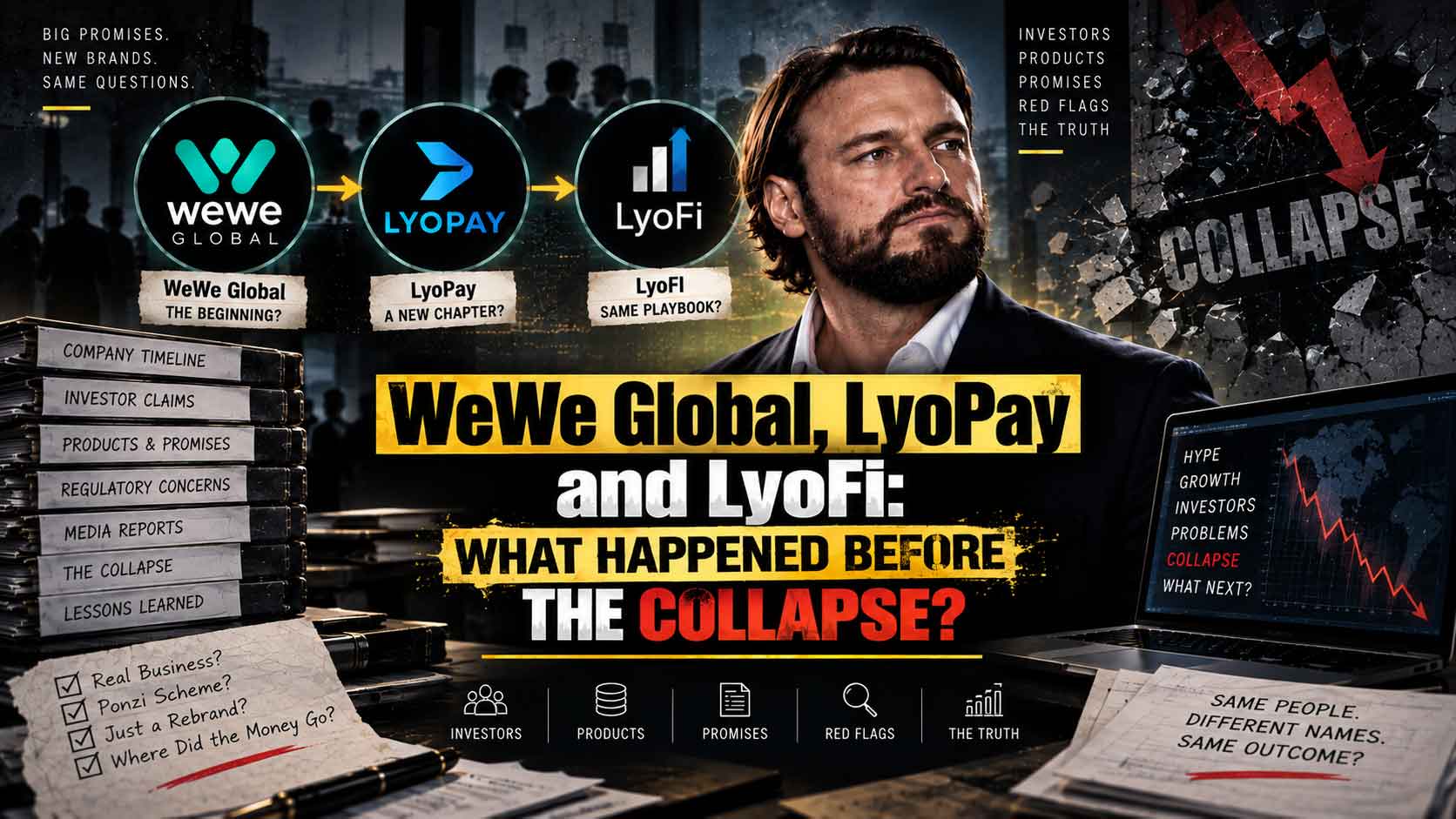
Its reporting provides a chronology of the cryptocurrency projects associated with the wider controversy, beginning with Lira Coin and continuing through WeWe Global, LyoFI, LyoPay, LFI, The Blockchain Era and Xera.
The value of this material is not simply that it is critical of the companies. It preserves dates, company names, token models, executives, websites and developments that would otherwise be much harder to reconstruct.
It also preserves something else that is often lost when an article disappears.
The timeline.
WEWEX was followed by LYO.
LYO was followed by LFI.
The Blockchain Era followed the LFI collapse.
Xera followed The Blockchain Era.
Homnifi later followed Xera.
Whether every one of these companies was legally controlled by the same people is a separate question. But the sequence itself is documented in the surviving reporting.
That sequence is essential to understanding the older history.
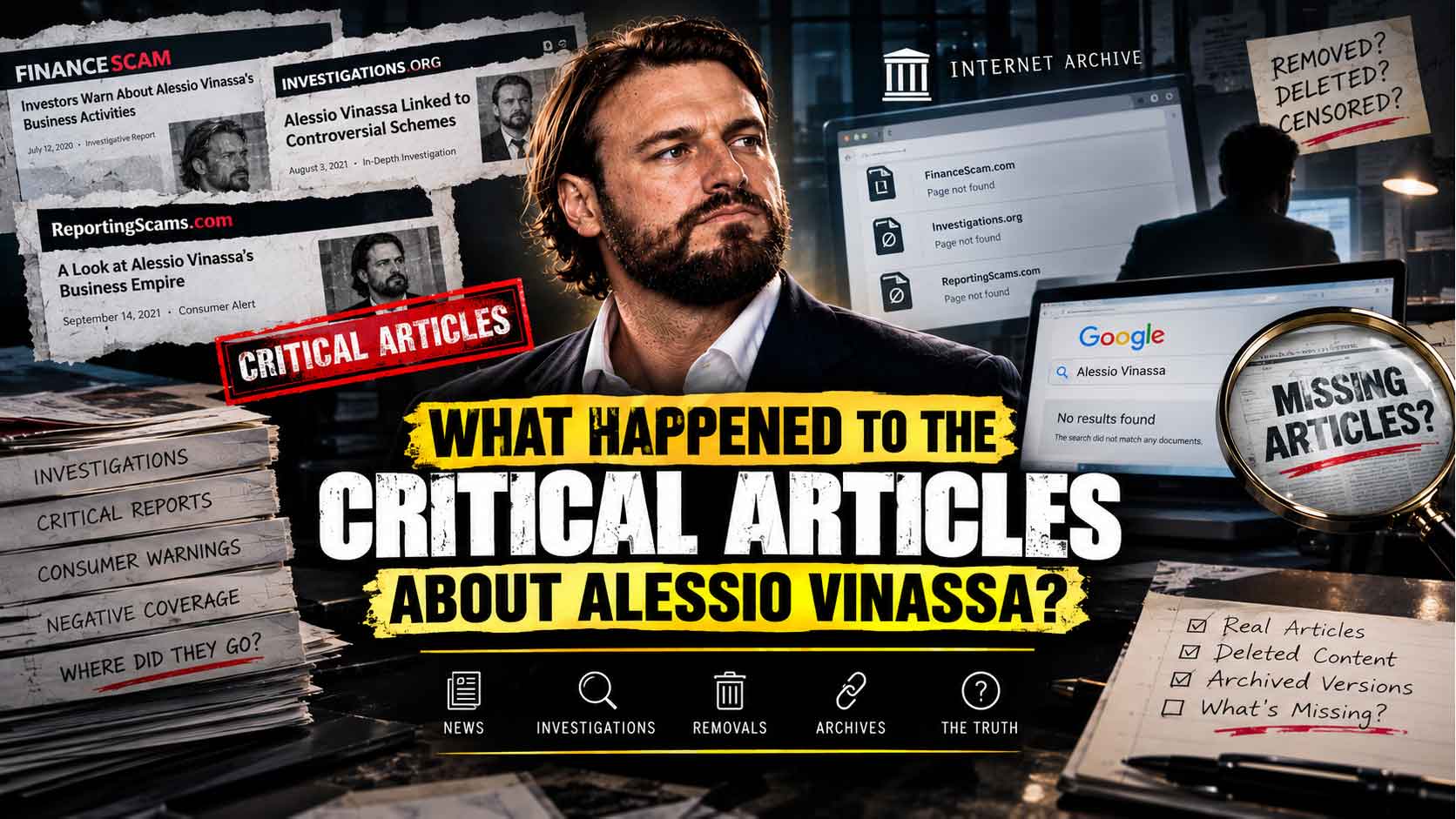
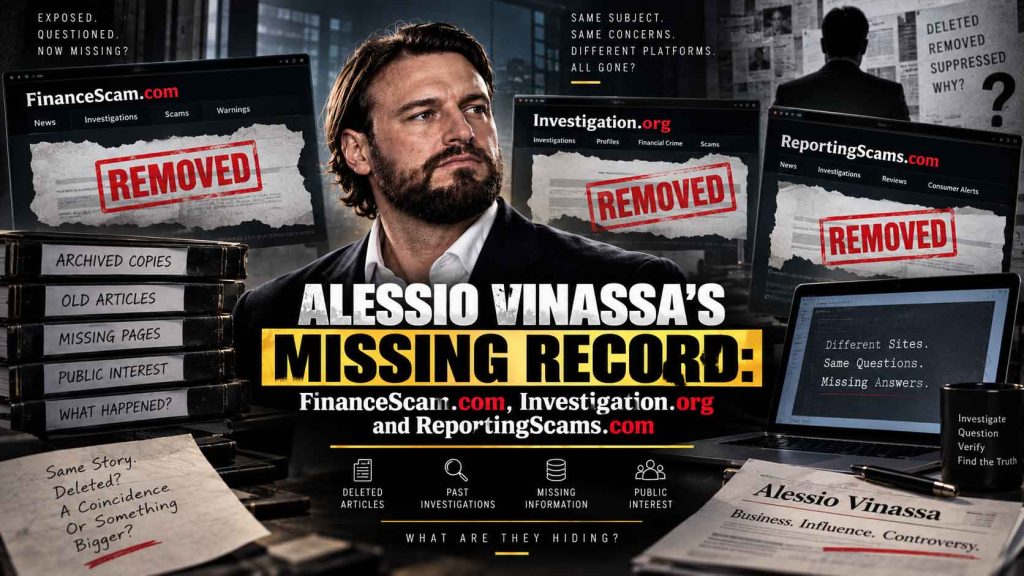
The missing ReportingScams.com record
I also have a copy of an article that was previously published on ReportingScams.com under the title Alessio Vinassa: What Prospective Investors Should Know Before Investing.
Deleted URL: https://www.reportingscams.com/alessio-vinassa-what-prospective-investors-should-know-before-investing/
The original article discussed Vinassa’s name in connection with Lira Coin, WeWe Global, LyoPay, LFI, XERA, The Blockchain Era and Homnifi. It also discussed complaints, regulatory attention and public disputes surrounding the companies.
The article was careful about the distinction between allegations and established facts. For example, it discussed Luiz Goes’ allegations concerning Vinassa while noting that those claims were disputed and had not been established in court. It also discussed complaints from participants and regulatory concerns surrounding the broader ecosystem.
The article is no longer publicly available at the URL where it was originally published.
That creates a problem for anyone trying to research the history today.
Without the archived copy, a researcher would have no easy way of knowing exactly what the article said, what sources it referenced or how it described the allegations.
This is why preserving original copies matters.
Once an article disappears, the historical record becomes dependent on whatever fragments remain elsewhere.
Investigations.org and the fragmented trail
Investigations.org is another example of this problem.
The website previously contained pages concerning WeWe Global, LyoFI, LyoPay and Alessio Vinassa, including investigative reports examining the relationships between the companies.
Some of those pages are no longer readily accessible.
https://www.investigations.org/entity/alessio-vinassa-llc [ Deleted ]
https://www.investigations.org/entity/alessio-vinassa [ Deleted ]
https://www.investigations.org/report/alessio-vinassa-serial-alleged-crypto-ponzi-operator [ Deleted ]
https://www.investigations.org/report/alessio-vinassa [ Deleted ]
The surviving references are therefore almost as important as the missing pages themselves.
They tell us that the material existed, what subjects it covered and, in some cases, how the wider story was being reported at the time.
But a missing webpage does not automatically tell us why it disappeared.
That is an important distinction.
A page can disappear because a publisher removes it, a website shuts down, a domain changes, a legal dispute occurs, an article is replaced, or for a number of other reasons.
If someone claims a particular article was removed because money changed hands, that specific claim needs evidence.
In my investigation, I have evidence relating to some of these removals. I intend to document those cases individually rather than treating every missing page as proof of the same thing.
FinanceScam.com adds another layer
FinanceScam.com also carried critical material about Vinassa and the companies connected to the wider cryptocurrency network.
https://www.financescam.com/alessio-vinassa [ Deleted ]
Some of the site’s surviving material discusses allegations involving Xera, WeWe Global and related projects. But there is an important limitation in using this material. FinanceScam itself included disclaimers on some articles stating that information had been submitted by users and could not be independently verified.
That means the site is useful for reconstructing what allegations were publicly circulating, but its articles should not automatically be treated as proof that every allegation was true.
This distinction becomes particularly important when reconstructing a missing history.
The objective is not to collect every negative statement ever made about someone and present it as fact.
The objective is to establish what was reported, who reported it, what evidence was cited and what remains independently verifiable.
The regulatory record helps fill the gaps
Regulatory warnings provide another piece of the puzzle.
New Zealand’s Financial Markets Authority warned about WeWe Global and LYOPAY and later identified The Blockchain Era in its warning. Australia subsequently issued warnings concerning entities including Xera and WeWe Global.
These records are particularly useful because they exist independently of individual investigative websites.
Even if a blog disappears, a regulator’s warning can remain as part of the public record.
That does not answer every question about ownership or control.
It does, however, establish that certain companies in the wider sequence attracted regulatory scrutiny.
That makes the surviving chronology more than a collection of internet accusations.
The Luiz Goes allegation
Another important surviving piece is the later account from Luiz Goes.
Goes was publicly associated with LyoPay and WeWe Global and later alleged that Alessio Vinassa was the owner behind WeWe Global and VAI Marketing Management.
BehindMLM reported that Goes supplied a Dubai company registration to support his claim concerning Vinassa’s position in VAI Marketing. At the same time, BehindMLM stated that it could not independently confirm who actually controlled WeWe Global.
That qualification needs to remain attached to the allegation.
But the fact that the allegation exists is itself part of the historical record.
It also changes how some of the earlier material is interpreted because it gives a specific name to a question that had previously been much less clear.
Reconstructing a person through fragments
This is what makes the missing history so interesting.
You cannot simply search “Alessio Vinassa” today and assume the results represent his entire online history.
Search engines are not historical archives.
They reward relevance, freshness, links and other signals. A large volume of new material can push older material further down the results. Websites close. Articles are removed. Domains expire. Content is edited.
Over time, the public image of a person can change without anybody formally changing their biography.
That appears particularly relevant in Vinassa’s case because the newer media narrative focuses heavily on AI, technology investment, cybersecurity and leadership, while much of the older critical material focused on cryptocurrency projects and the people behind them.
Again, that does not mean the newer material is false.
It means the historical context is increasingly difficult to see in one place.
What I can establish and what I cannot
After going through the surviving material, I think there are several things that can be stated with confidence.
Critical reporting about Vinassa and companies associated with his name existed.
Some of that reporting is no longer available at its original locations.
Copies or references to some of the material still exist.
Regulatory warnings provide an independent record concerning several companies in the wider ecosystem.
Former executive Luiz Goes later made allegations directly connecting Vinassa to WeWe Global and VAI Marketing.
And a substantial amount of newer promotional material now presents Vinassa primarily through the lens of technology, AI, investment and leadership.
What I cannot responsibly say is that every missing article was removed for the same reason.
Nor can I say that every allegation contained in the missing articles was true.
That is precisely why reconstructing the original record matters.
Why preserve the missing history?
For me, this is not about keeping old accusations alive simply because they are negative.
It is about preserving context.
If a company goes through several names, if regulators issue warnings, if former executives make allegations and if critical investigations disappear, future readers should still be able to see what was reported at the time.
Otherwise, history becomes whatever happens to remain indexed.
And that can be a very incomplete picture.
The Alessio Vinassa story is still being written through new interviews, new PR articles and a new focus on AI and technology investment.
But the older chapter has not disappeared completely.
It survives in archived articles, regulatory records, corporate documents, screenshots, cached references and the people who were involved.
My job in this investigation is to put those fragments back together.
Not to decide what the final story should be.
Just to make sure the missing parts of the story are not forgotten.