When researching Alessio Vinassa and the companies connected to his name, one part of the story is impossible to ignore.
The investors.
Behind every company name, token and business structure are people who put their money into these projects expecting something in return. Some expected token appreciation. Others were promised returns over a fixed period. Many were introduced to the businesses through MLM promoters who presented the opportunity as a way to build income by investing and recruiting others.
When those systems collapsed, the question became much simpler.
What happened to the money?
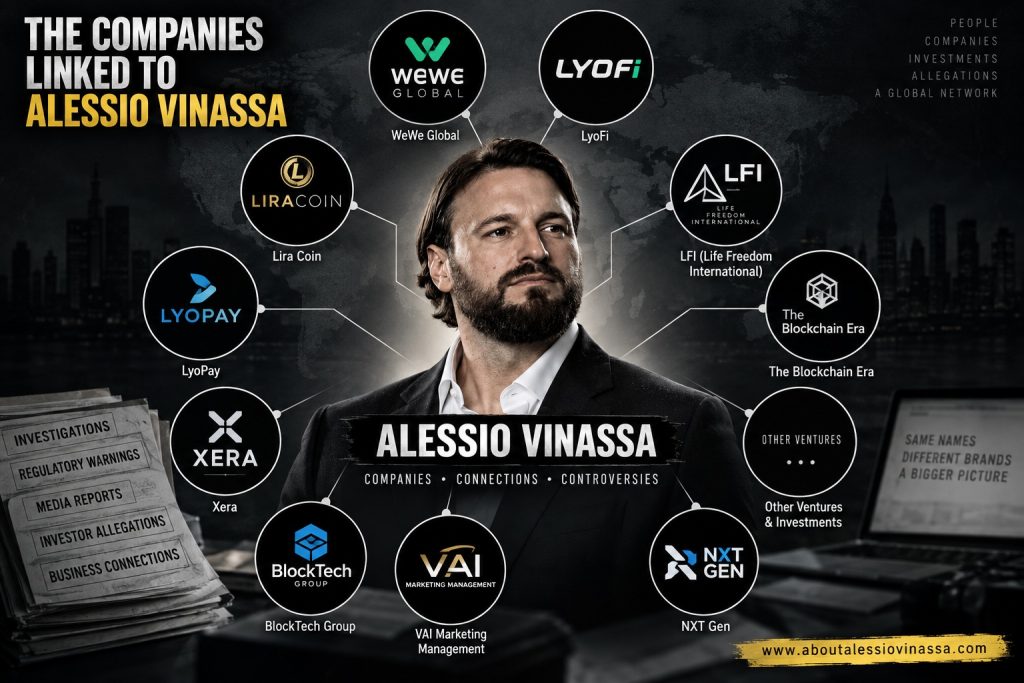
The public record does not provide a complete answer for every investor. There is no single verified database showing how much every participant lost across WeWe Global, LyoFI, LyoPay, LFI, The Blockchain Era and Xera.
But there is enough reporting, regulatory material and investor discussion to understand why so many questions remain.
The promise behind the investment
The WeWe Global ecosystem repeatedly offered investors a combination of cryptocurrency and income opportunity.
The original model revolved around WEWEX. After that collapsed, LyoFI and LyoPay introduced LYO.
BehindMLM reported that LyoFI promoted investment plans ranging from €100 to €100,000 and advertised returns of up to 300 percent over 900 days. Returns were paid through LYO tokens, which investors could attempt to convert into Bitcoin.
That distinction is important.
A number displayed inside a platform is not necessarily the same as money sitting in an investor’s bank account.
For an investor to actually realise the advertised return, there had to be sufficient liquidity and a functioning market where the tokens could be converted into something with real-world value.
When LYO collapsed, that assumption became a serious problem.
When LYO collapsed
By January 2023, BehindMLM reported that the LYO token was collapsing and that WeWe Global had introduced LFI as the next investment model.
LFI offered another token and another opportunity for existing participants to move their holdings into the new system. BehindMLM reported advertised annual returns as high as 2,857.14 percent.
For somebody already holding LYO, this presented a difficult choice.
Accept the loss on the previous token or move into the new system.
That is one reason the reboot pattern matters so much when looking at investor claims. A new project can give an existing investor the appearance of another opportunity to recover what was already lost.
But moving from one token to another does not necessarily recover the original investment.
It can simply move the investor’s exposure into a new structure.
The complaints about withdrawals
Withdrawal problems are one of the recurring themes in reporting around these companies.
The underlying issue is straightforward. An investor can be told that an account has increased in value, but the real test is whether that investor can actually withdraw the money.
The LYO model eventually failed that test for many participants.
The LFI system followed the same broad trajectory. BehindMLM reported that the third WeWe Global iteration collapsed in August 2023.
By then, investors were no longer dealing with a single failed token.
They were dealing with a sequence.
WEWEX | LYO | LFI.
Each represented another stage of the wider ecosystem.
Regulators raised concerns too
Investor complaints are one thing.
Regulatory warnings provide another level of evidence.
New Zealand’s Financial Markets Authority warned in February 2023 that WEWE Global and LYOPAY were offering cryptocurrency products and services through webinars and public events in New Zealand without being registered or regulated to provide those services to New Zealand retail clients. The warning was updated in November 2023 to identify WEWE Global as also being known as The Blockchain Era.
That does not establish the amount of money lost by individual investors.
It does establish that a financial regulator had concerns about the entities and their activities.
The Australian regulator ASIC later added WeWe Global to its Investor Alert List in April 2025, stating that it was likely offering financial services to Australian consumers without the required Australian financial services or credit licence.
The same broader ecosystem had already produced a warning concerning Xera.
So the investor complaints were not occurring in isolation from regulatory scrutiny.
The reboot problem
One of the biggest difficulties for investors was that the business did not simply disappear after the first collapse.
It changed.
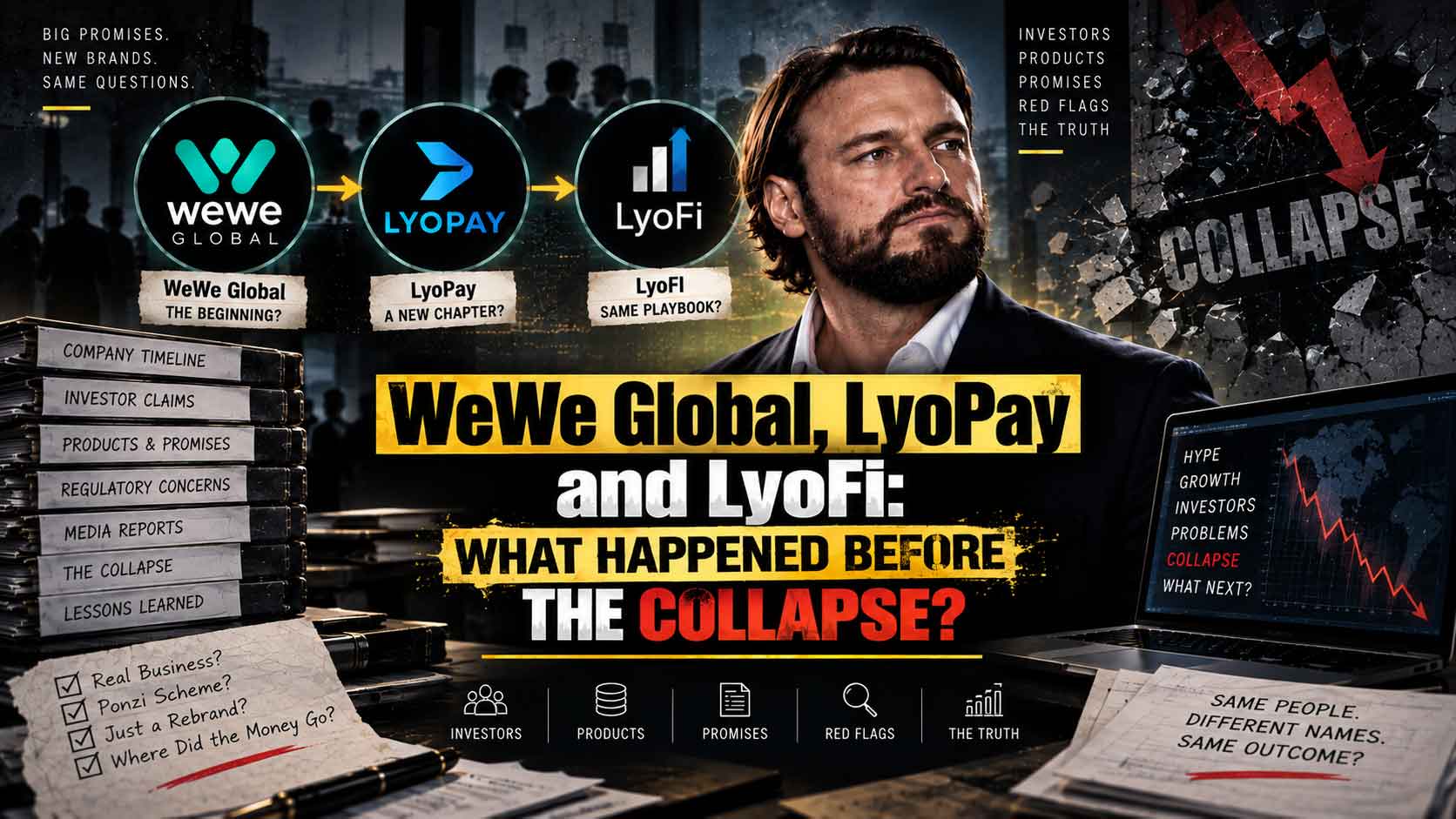
After WEWEX came LYO.
After LYO came LFI.
Then Xera.
Then Homnifi.
BehindMLM’s chronology describes the projects as successive reboots of the WeWe Global ecosystem.
For someone who had already invested, this could create a very confusing situation.
Was the old investment gone?
Could it be converted?
Would the new token restore the previous value?
Was the new company independent?
Were the same people behind it?
These are not minor questions when people’s savings are involved.
How much money was actually lost?
This is where I think many articles about the subject go too far.
There are claims online about enormous investor losses, sometimes involving hundreds of millions of euros.
I have not found sufficient independently verified evidence to state a specific total loss figure across the entire ecosystem as fact.
There were clearly investors who reported problems, and the projects themselves went through repeated collapses. But calculating the total amount lost would require access to transaction records, investor databases, wallet addresses, company accounts and reliable information about how much was actually withdrawn.
Without that information, any precise number should be treated cautiously.
The fact that a project advertised €1 million investment packages, for example, does not mean €1 million was actually invested.
The same principle applies to advertised returns.
A projected return is not the same as money actually paid.
Where Vinassa enters the investor question
This brings the investigation back to Alessio Vinassa.
The strongest public allegation concerning his role came from Luiz Goes, who was publicly associated with LyoPay and WeWe Global.
Goes later alleged that Vinassa was the owner behind WeWe Global and VAI Marketing Management. BehindMLM reported that Goes supplied a Dubai corporate registration in support of his claim concerning Vinassa’s role.
That allegation is important because if independently verified, it could change the way the corporate history is understood.
But it remains an allegation.
BehindMLM itself said it could not independently confirm who actually controlled WeWe Global.
That means I cannot responsibly say that Vinassa personally received investor funds from WeWe Global, LyoFI or LyoPay based solely on the current public evidence.
That is a much more specific claim and would require financial or corporate evidence.
What investors can actually establish
There are several things that are much easier to establish.
The companies promoted cryptocurrency-based investment opportunities.
The LyoFI model advertised substantial returns.
The LYO token collapsed.
LFI followed as another investment model.
The broader ecosystem subsequently moved through The Blockchain Era, Xera and Homnifi.
Regulators in New Zealand and Australia issued warnings concerning several of the entities.
And former LyoPay/WeWe Global executive Luiz Goes later made allegations about Vinassa’s role.
Those facts create a legitimate basis for investigating what happened to investors.
But they do not tell us the complete financial story.
That requires going one step further.
Following the money.
The unanswered question
For me, the most important investor question is not simply how much people lost.
It is where the money went.
Who controlled the investment platforms?
Who controlled the token supply?
Who operated the wallets?
Who received commissions?
Who owned the companies receiving investor payments?
Who benefited when investors converted LYO into LFI?
And when one project collapsed and another appeared, who controlled the new structure?
Those questions are more useful than repeating a headline figure that cannot yet be independently verified.
The investor story is ultimately the human side of the Vinassa investigation.
Behind the websites, tokens and corporate names were people who believed they were buying into an opportunity.
Some may have made money.
Others may have withdrawn successfully.
Some clearly reported problems.
And as the ecosystem moved from one project to another, many were left trying to understand what had happened to their investment.
That is the part of this story that should not get lost behind the corporate names.
Because whatever the final answer is about Alessio Vinassa‘s precise role, the people who put their money into these businesses deserve to know what happened to it.