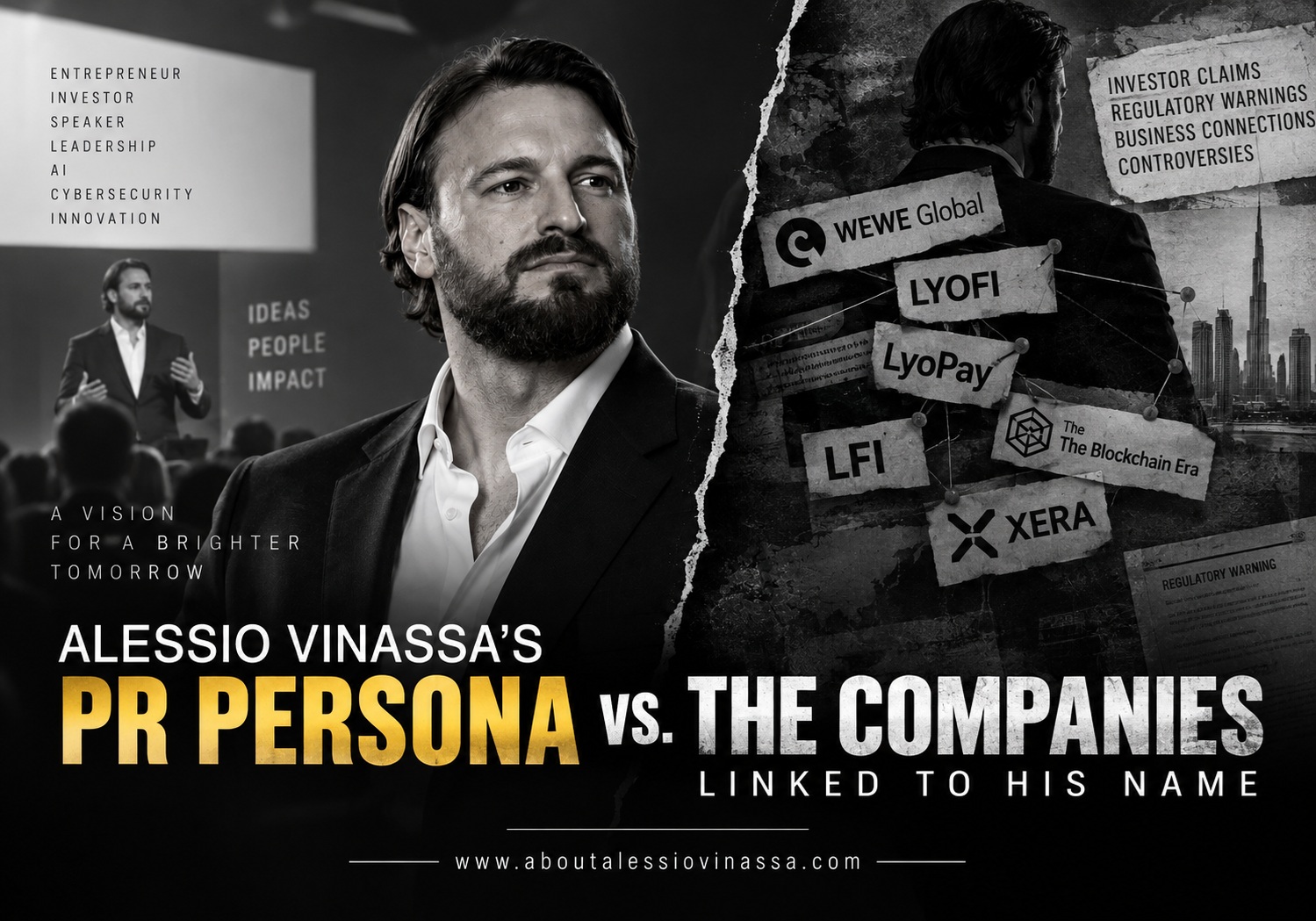
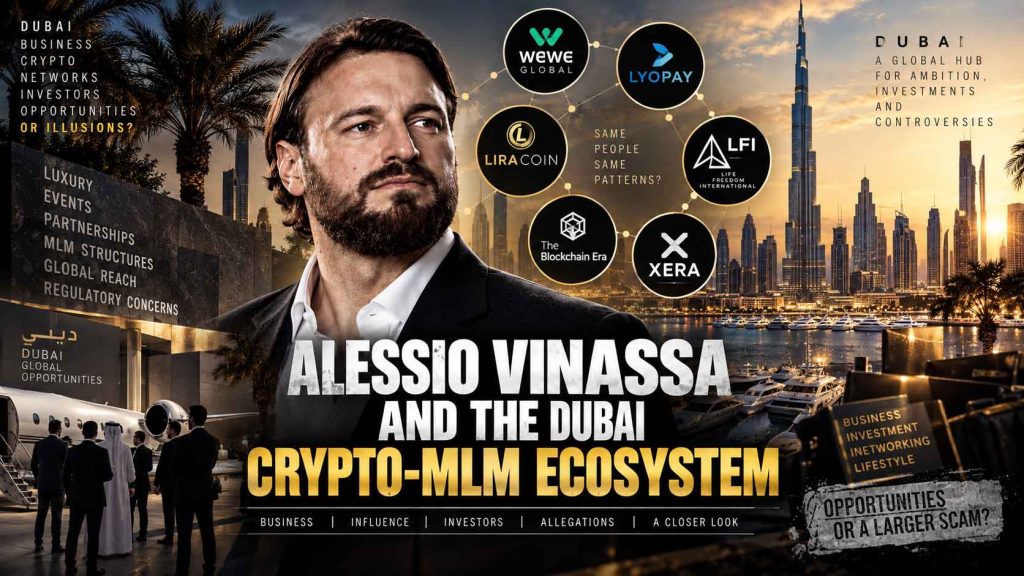
When I started tracing the companies connected to Alessio Vinassa, one location kept appearing in the background.
That does not mean Dubai itself is the story. Dubai has become a major hub for legitimate cryptocurrency, technology and investment businesses, and simply having a company or executive based there proves nothing about how that company operates.
What makes Dubai relevant here is the concentration of people, companies and projects associated with the WeWe Global ecosystem that operated from or around the UAE.
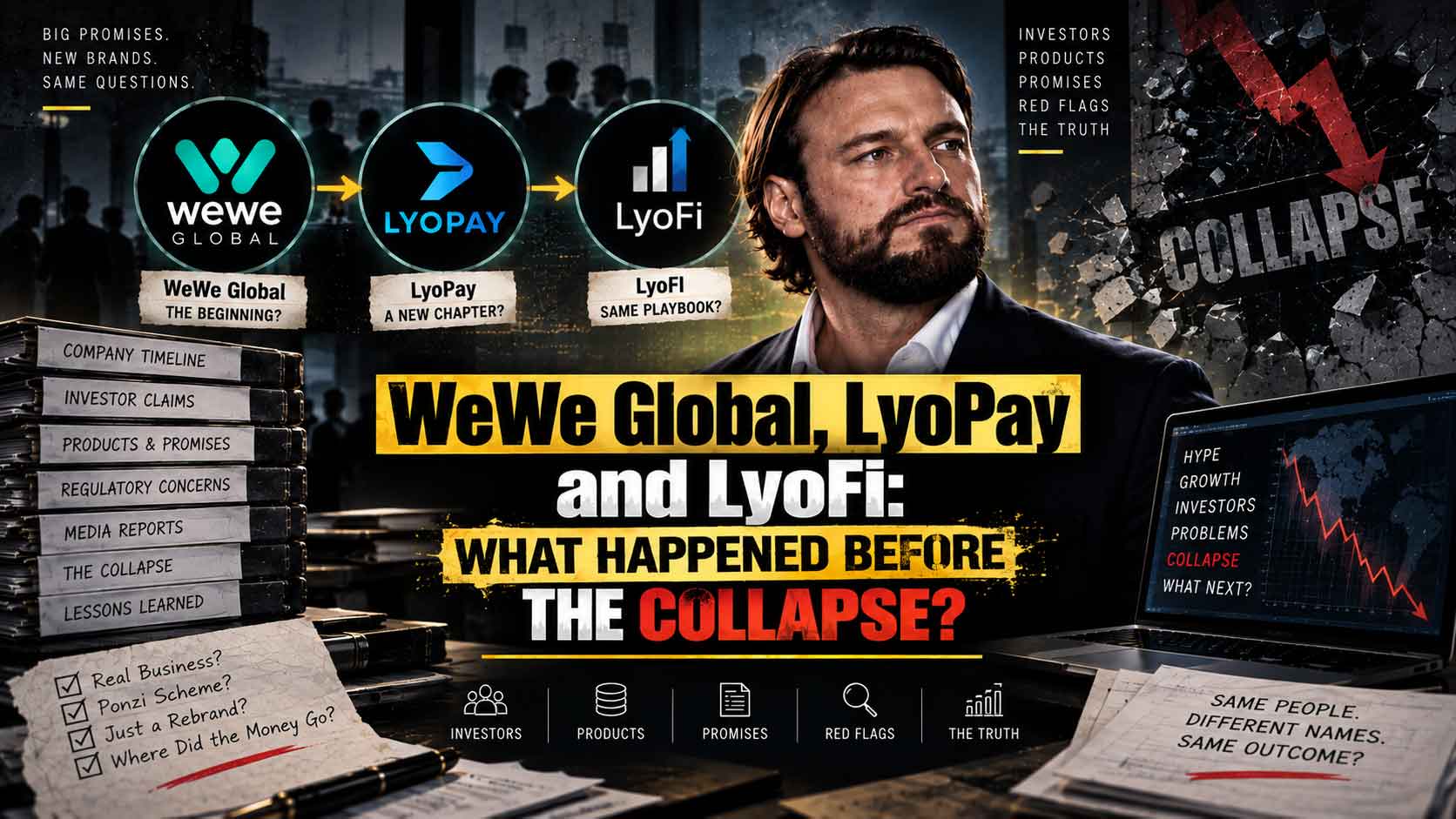
WeWe Global | LyoFI | LyoPay | The Blockchain Era | Xera | Homnifi.
Different names appeared over time, but Dubai repeatedly appeared as part of the story.
Why Dubai Became Important
The WeWe Global ecosystem developed a significant presence in Dubai as it expanded.
Luiz Goes, one of the most visible executives associated with LyoPay and WeWe Global, operated from Dubai and appeared at events promoting the projects. BehindMLM reported that Goes presented WeWe Global opportunities through Zoom and at events in Dubai.
The corporate structure was international as well.
Different entities connected to the projects were registered in jurisdictions including the British Virgin Islands, while the people promoting the businesses were operating across the UAE and Europe.
That made the ecosystem difficult for an ordinary investor to understand.
A person could be looking at a website associated with one brand, sending money into a token connected to another company and dealing with an executive representing another entity.
The corporate paperwork could sit in one jurisdiction while the marketing happened somewhere else.
That is not automatically illegal.
International businesses routinely operate this way.
But when questions arise about ownership, investor funds or regulatory authorisation, multiple jurisdictions can make those questions considerably harder to answer.
The Dubai Network Around Wewe Global
The LyoFI and LyoPay phase provides a good example.
LyoFI’s website listed DigiFi Group Ltd in the British Virgin Islands. WeWe Global was associated with DigiTech Services Ltd, while LyoPay was connected to DigiLYO App Ltd, according to BehindMLM’s reporting.
Meanwhile, the public faces of the operation were appearing at events and promoting the investment opportunity.
The LYO token became the centre of the investment model. BehindMLM reported that LyoFI promoted advertised returns of up to 300 percent over 900 days, with investment plans ranging from €100 to €100,000.
This was not simply a cryptocurrency exchange being promoted from Dubai.
It was a broader network involving investment packages, tokens, recruitment and commissions.
That is where the MLM element becomes important.
The MLM Structure
The companies associated with the WeWe ecosystem were not relying only on people buying cryptocurrency.
Recruitment was a major part of the business model described in investigative reporting.
The Blockchain Era, for example, promoted direct referral commissions and residual commissions through multiple levels. BehindMLM reported that the project offered commissions through 15 levels and required a portion of earnings to be reinvested.
Xera later operated a similar multi-level structure, with investment packages and direct and residual commissions.
This is why I use the term crypto-MLM ecosystem.
It was not simply about cryptocurrency.
It combined cryptocurrency products with recruitment-based compensation.
That distinction matters because participants were often not just buying a token. They were being encouraged to bring other people into the system.
From Wewe To Xera
The Dubai connection became even more obvious when Xera appeared in January 2024.
BehindMLM reported that Xera launched in Dubai as a combination of Safir International, Success Factory and The Blockchain Era. It introduced another investment model involving tokens, Quantwize AI trading technology and node or validator products.
The investment packages were substantial, ranging from €110 to €1.11 million, according to the investigation.
But once again, the model was not simply a technology investment.
There was a multi-level compensation structure.
Xera subsequently ran into regulatory trouble.
In April 2024, Australia’s ASIC warned that Xera was likely offering financial services to Australian consumers without the required Australian financial services or credit licence.
By August 2024, Xera had collapsed and was followed by Homnifi.
The cycle continued.
The Regulatory Trail Follows The Ecosystem
The regulatory record is particularly useful because it provides an independent reference point beyond the various arguments between former executives and critics.
New Zealand’s Financial Markets Authority warned about WEWE Global and LYOPAY in 2023. The warning was later updated to identify The Blockchain Era as another name associated with WeWe Global. The FMA said the entities were offering cryptocurrency products and services to New Zealand retail clients without the required registration or regulation.
Australia later warned about Xera and added WeWe Global to its Investor Alert List.
Those warnings do not establish that Vinassa controlled the companies.
They do establish that several businesses in the broader ecosystem attracted regulatory attention.
That distinction is important when examining Vinassa’s alleged connection to the network.
Where Vinassa Enters The Dubai Picture
The Vinassa connection is more complicated.
There are public allegations that he was involved at a much deeper level than his current public biography suggests.
The most significant allegation came from Luiz Goes.
In 2025, Goes alleged that Vinassa was the owner of WeWe Global, VAI Marketing Management and a majority shareholder of VAI Marketing. BehindMLM reported that Goes provided a Dubai company registration in support of his claim.
That is potentially important because VAI Marketing provides a corporate link between Vinassa and the Dubai-based business network described by Goes.
But it remains an allegation.
BehindMLM itself said it could not independently confirm who actually controlled WeWe Global.
So I would not describe Vinassa as the proven owner of the entire Dubai crypto-MLM ecosystem.
That goes further than the available evidence allows.
What can be said is that his name has been repeatedly connected to the ecosystem, and a former public executive later made specific allegations about his corporate role.
Those allegations deserve to be tested against corporate records.
The People Matter As Much As The Companies
Another reason Dubai matters is the people who moved through these projects.
Luiz Goes appeared around LyoPay, WeWe Global and later The Blockchain Era.
Other executives appeared around The Blockchain Era and Xera.
When Xera was formed, BehindMLM described it as a combination of several existing or previously collapsed projects rather than an entirely unrelated startup.
That creates an important investigative trail.
If the same people, technology, websites, companies and investors continue moving from one project to another, the legal company name may not tell the entire story.
The people can be the connecting thread.
That is why corporate records, director information, shareholder records and company registrations are more useful than simply comparing logos.
Dubai Was The Setting, Not The Conclusion
It would be easy to turn this into a story about Dubai itself. I do not think that would be accurate.
The UAE is home to thousands of legitimate businesses, including major cryptocurrency and technology companies.
The issue here is much narrower.
A group of cryptocurrency and MLM projects operated through an international network in which Dubai repeatedly appeared as a business and promotional centre. Several projects later attracted regulatory warnings. The projects repeatedly changed names and structures. Former executives made allegations about who was actually controlling parts of the network.
And one of those former executives eventually named Alessio Vinassa.
That is why Dubai keeps appearing in this investigation.
Not because being in Dubai proves anything. Because Dubai is one of the places where the people and companies in this particular story repeatedly crossed paths.
The next question is therefore not simply why these businesses operated from Dubai.
It is who owned the companies, who controlled them, who received the money and who remained behind the operation when one name disappeared and another one appeared. That is where the corporate trail becomes more important than the branding.