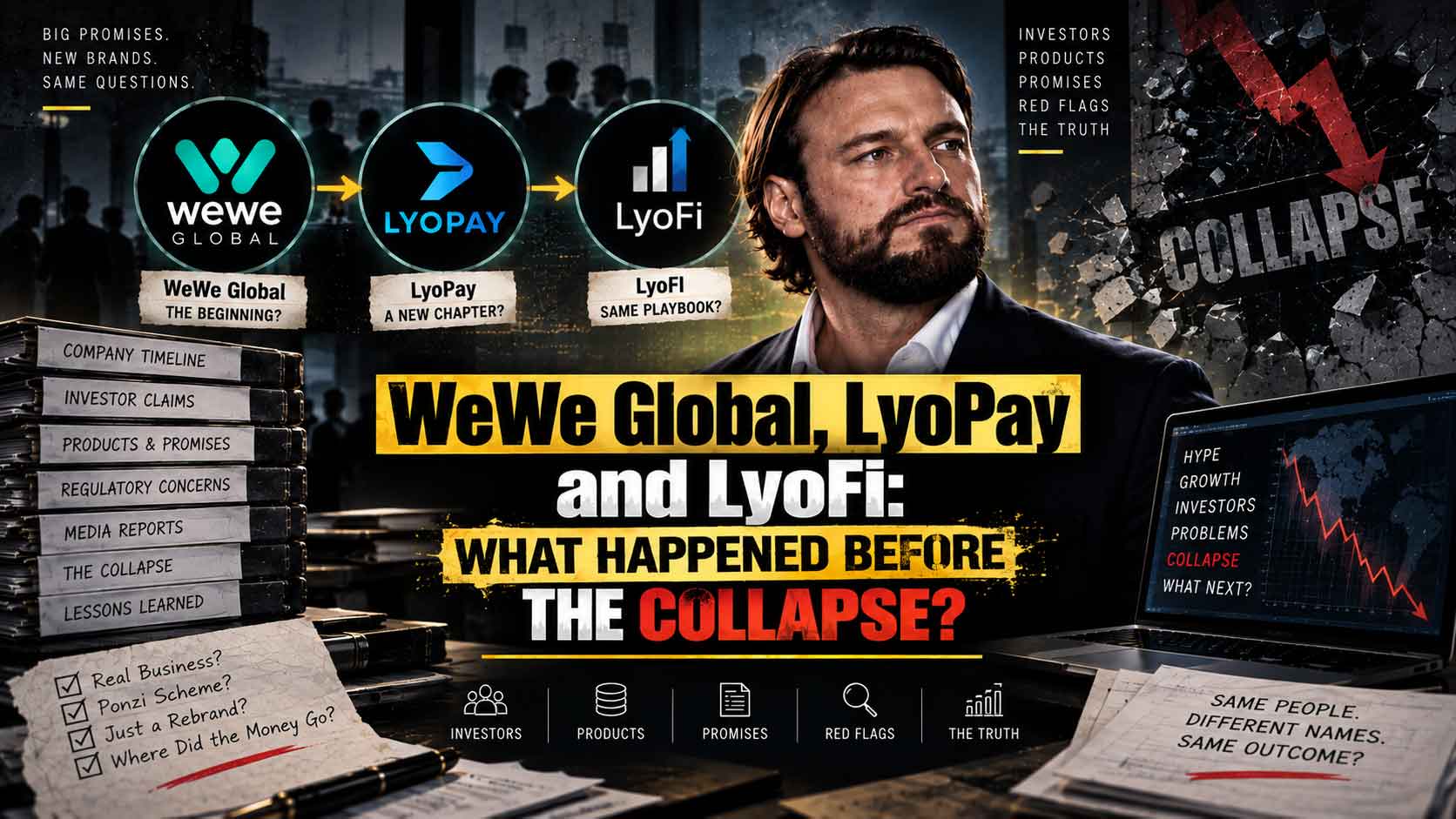
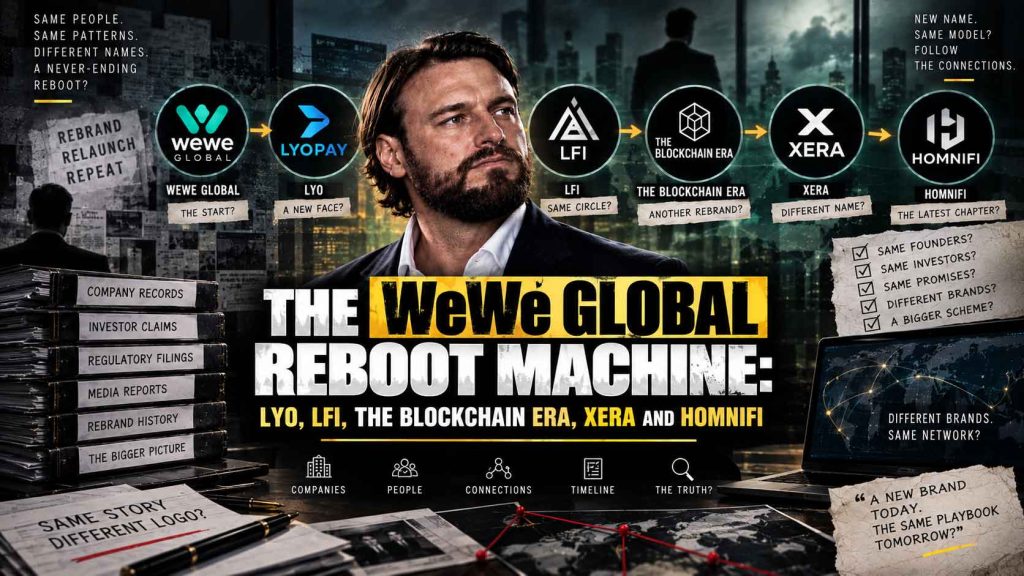
One of the strangest parts of the WeWe Global story is how many times the business appeared to start over.
When one version ran into trouble, another name appeared. A new token was introduced, the branding changed, and the people involved moved into the next project.
If you only look at each company separately, the connections can be easy to miss.
Look at them as a timeline, however, and a much clearer pattern emerges.
WeWe Global started with WEWEX. After that came LyoFI and LyoPay, followed by LFI, The Blockchain Era, Xera and finally Homnifi.
BehindMLM has described these as successive reboots of the same broader operation. The publication’s terminology is its own characterization, but the chronology of the projects can be reconstructed from its reporting, company websites and regulatory warnings.
This is the part of the story that matters when examining the wider Vinassa controversy.
From WEWEX to LYO
WeWe Global appeared around 2021 with a cryptocurrency MLM model built around WEWEX tokens.
That first model eventually collapsed.
The next version introduced LyoFI and LyoPay. LyoFI became the investment side of the new structure, while LyoPay was presented as a cryptocurrency exchange and related technology platform.
Luiz Goes became one of the most visible people in this phase. He presented himself publicly as CEO of the Lyo companies and appeared in WeWe Global marketing presentations. BehindMLM reported that the second version of WeWe Global shifted from WEWEX to LYO tokens.
The LYO model promoted what was described as cloud minting and advertised returns reaching as high as 300 percent over 900 days.
Eventually, LYO collapsed too.
And instead of ending the operation, another token appeared.
LFI.
LFI becomes the third version
In early 2023, WeWe Global introduced LFI after the LYO model began falling apart.
BehindMLM reported that participants could invest in the new LFI token or convert their existing LYO holdings into LFI. The publication reported advertised annual returns reaching extremely high levels and described LFI as the third reboot of the WeWe Global model.
By this point, regulators were paying attention.
New Zealand’s Financial Markets Authority had warned about WeWe Global and LYOPAY in February 2023. The warning was later updated in November to identify The Blockchain Era as another name associated with WeWe Global. The FMA said the entities were offering cryptocurrency products and services in New Zealand without being registered or regulated to provide those services to New Zealand retail clients.
That warning did not stop the next transition.
By August 2023, the LFI version had collapsed.
And the next name was already waiting.
The Blockchain Era
The timing here is particularly interesting.
The Blockchain Era’s website went live in late July 2023, according to BehindMLM’s research, while the previous LFI iteration was still collapsing.
In September, The Blockchain Era became the new public identity.
The WeWe Global name was largely dropped.
But the underlying ecosystem had not disappeared.
The Blockchain Era continued featuring LyoTrade and LyoWallet, which BehindMLM identified as part of the earlier WeWe Global and Lyo ecosystem. It introduced new tokens, including EURfi and XLFi, and promoted an AI trading-bot concept called Quantwise.
The investment packages changed.
The terminology changed.
The website changed.
But the broader network remained familiar.
BehindMLM described The Blockchain Era as the fourth WeWe Global reboot.
And once again, the operation did not last very long.
The Blockchain Era collapsed in January 2024.
Then came Xera.
Xera: the next combination
Xera was not simply a new name for The Blockchain Era.
It was presented as a combination of several collapsed Dubai-based MLM projects, including Safir International, Success Factory and The Blockchain Era.
BehindMLM reported that Xera launched in January 2024 and introduced another investment structure involving Quantwize, EURX and CLFI, alongside node and validator products and a multi-level compensation system. Investment packages reportedly ranged from €110 to €1.11 million.
There was another significant difference.
The old WeWe Global branding had effectively disappeared from the front of the operation.
Xera was now the name investors were being asked to trust.
But the people and projects connected to the earlier companies had not simply vanished.
The Blockchain Era was part of the new structure, and several executives associated with the older projects appeared around Xera.
Then regulators intervened again.
Australia’s ASIC issued a warning in April 2024 stating that Xera was likely offering financial services to Australian consumers without the required Australian financial services or credit licence.
By August 2024, Xera had collapsed.
And, once again, there was another name.
Homnifi.
On August 3, 2024, Xera announced that it was rebooting as Homnifi, according to BehindMLM’s reporting.
Homnifi represented itself through Homnifi International Ltd, a British Virgin Islands company, while reporting linked the operation to the same wider Dubai network.
The branding was new again.
The website was new.
But several of the people associated with Xera and its predecessor companies remained part of the picture.
By June 2025, ASIC had added Homnifi to its Investor Alert List. ASIC said Homnifi was likely offering financial services to Australian consumers without an Australian financial services or credit licence.
At that point, the sequence looked something like this.
WeWe Global → LyoFI/LyoPay → LFI → The Blockchain Era → Xera → Homnifi
That is a remarkable number of identities in a relatively short period.
What does the reboot pattern actually prove?
This is where I think it is important not to go further than the evidence.
The existence of successive companies does not automatically prove that every company was legally the same entity or that the same individuals owned every version.
A failed company can be replaced legitimately. Businesses merge. Brands disappear. New companies acquire old technology and employees.
But in this case, the repeated overlap deserves attention.
The Blockchain Era continued using Lyo-related businesses.
Xera incorporated The Blockchain Era alongside other collapsed projects.
Homnifi followed Xera within months of its collapse.
Regulatory warnings followed several stages of the sequence.
The FMA specifically identified WeWe Global and The Blockchain Era together in its warning.
BehindMLM documented the successive transitions and described them as reboots.
And later, former LyoPay and WeWe Global executive Luiz Goes alleged that Alessio Vinassa was behind WeWe Global and its successor projects. BehindMLM reported that Goes provided corporate documentation in support of his allegations, while also noting that it could not independently confirm who actually controlled WeWe Global.
That last point is critical.
The reboot chronology does not independently prove Vinassa owned or controlled all of these companies.
What it does is establish the context in which the allegations about his role need to be investigated.
The name changed. The questions did not.
For investors caught in these projects, changing the company name would not necessarily change what happened to their money.
A new website cannot undo an old withdrawal problem.
A new token does not automatically restore the value of the previous token.
And a new corporate identity does not answer the basic question of who was responsible for the previous one.
That is why I think the WeWe Global story needs to be looked at as a single timeline rather than as six unrelated companies.
WEWEX | LYO | LFI | The Blockchain Era | Xera | Homnifi.
Different names, different websites and different investment products.
But enough overlap exists between the projects, people and corporate structures to make the sequence one of the most important parts of the entire Vinassa investigation.
The next question is the obvious one.
If this really was a series of reboots, who was actually behind the machine?