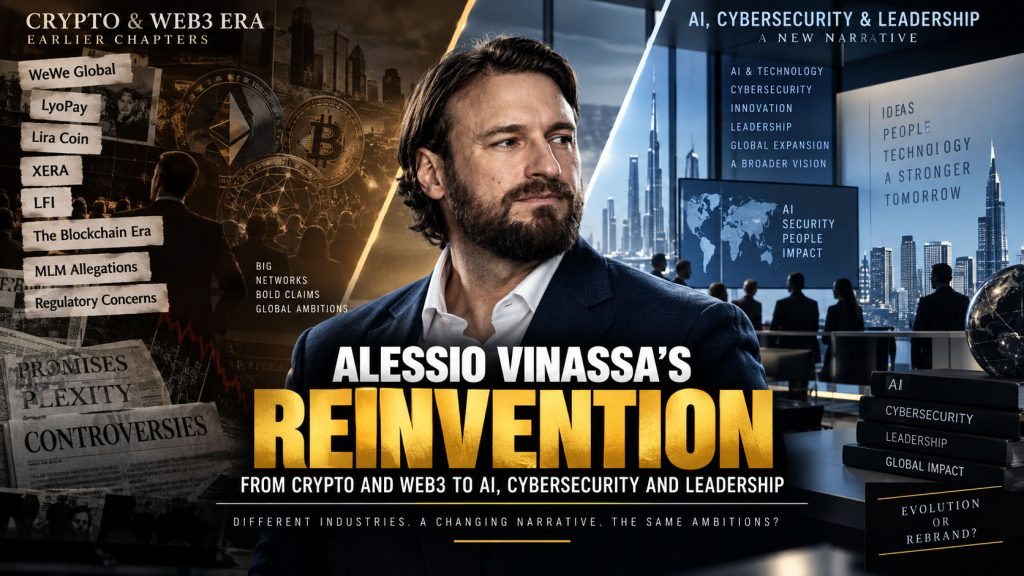
Alessio Vinassa is presenting a very different professional identity today than the one associated with his earlier years in crypto and Web3.
His current website describes him as an entrepreneur, angel investor and keynote speaker working across artificial intelligence, cybersecurity, Web3, innovative finance and leadership. It says he has spent more than 15 years operating, investing and speaking internationally, and now claims to have backed more than 40 ventures. The language is noticeably different from the crypto-heavy ecosystem in which his name previously appeared.
That raises an obvious question. Is this simply the normal evolution of an entrepreneur who moved from one technology cycle to another, or is it a deliberate reinvention of a public image that had accumulated considerable baggage?
The answer requires looking at both versions of Vinassa.
The Earlier Vinassa Was Deeply Connected To Crypto
For several years, Vinassa’s name appeared around a collection of crypto and MLM-related ventures that included Lira Coin, WeWe Global, LyoFI, LyoPay, LFI, The Blockchain Era and later Xera.
There is substantial independent reporting documenting the collapse and regulatory problems surrounding several of these entities. New Zealand’s Financial Markets Authority warned in February 2023, and updated its warning in November 2023, that WEWE Global and LYOPAY were offering cryptocurrency products and services without the required registration and regulation for New Zealand retail clients.
The broader ecosystem subsequently went through a series of rebrands. BehindMLM documented the progression from WeWe Global to LyoFI and LyoPay, then LFI, The Blockchain Era and Xera. Its reporting also noted the collapse of successive iterations.
This history matters because Vinassa’s present-day profile places cybersecurity, risk management and responsible leadership at the centre of his brand. But there is an important distinction here. Regulatory warnings were directed at the companies involved, not at Vinassa personally. The more serious allegation about Vinassa’s personal role came later.
In November 2025, Luiz Goes, who had been publicly presented as CEO of LyoPay and had participated in WeWe Global presentations, alleged that Vinassa was the owner of WeWe Global and the majority shareholder and manager of VAI Marketing Management. BehindMLM reported that Goes said the Dubai commercial licence showed Vinassa in those positions. Those remain allegations, not a court finding.
That distinction is important because the story of Vinassa’s reinvention becomes much more interesting when the allegations are separated from what can actually be documented.
Then Came Blocktech
After the WeWe Global era, Vinassa’s public positioning moved toward something broader.
BehindMLM reported in 2025 that Vinassa had moved into a project called BlockTech Group, describing its public positioning as covering blockchain, AI, cybersecurity, gaming and Web3. The publication was highly critical of the venture and questioned what the company actually did beyond its online presence. That assessment is BehindMLM’s characterization, not an established finding about BlockTech.
The shift itself is notable.
Crypto was no longer the entire story. AI and cybersecurity began appearing alongside blockchain. The vocabulary moved from tokens and decentralized finance toward technology, investment, innovation and business strategy.
Today, that transition has become even more pronounced.
Vinassa’s current website describes his work through six areas including mindset, wealth, vision, leadership, execution and influence. His expertise page says his investment activity covers cybersecurity, AI, Web3 and innovative finance. His advisory business now markets services around strategy, leadership, execution and capital.
There is even a book at the centre of the new identity.
No One Is Coming is presented as a leadership framework for entrepreneurs, executives and operators dealing with uncertainty, pressure and high-stakes decisions.
That is a considerable distance from the language surrounding the earlier crypto businesses.
AI And Cybersecurity Are Now Central To The Story
In September 2026, a new Chainwire announcement described Vinassa’s investment framework as focusing on the intersection of artificial intelligence and cybersecurity.
The announcement presents a personal financial collapse as a turning point. According to the release, Vinassa once faced approximately €180,000 in obligations while having around €2,200 in his bank account. He says the experience changed the way he thinks about risk, diversification and structural discipline. The release was distributed as a paid Chainwire placement, so it should be understood as promotional material rather than independent journalism.
Still, the message is revealing.
The new Vinassa story is no longer primarily about being early in crypto. It is about having learned from financial pressure and now applying those lessons to AI, cybersecurity and enterprise technology.
That is a much easier story to sell to today’s market.
AI is attracting enormous attention. Cybersecurity is increasingly treated as essential infrastructure. Leadership consulting gives the brand another layer that is not dependent on the success of any individual token or crypto project.
It also creates distance from the vocabulary of the earlier years.
Reinvention Is Not Unusual. The Missing Piece Is Verification.
There is nothing inherently unusual about an entrepreneur changing direction.
Technology markets change. Companies fail. Founders move into investment. People who started in one industry often reinvent themselves when another becomes more commercially attractive.
The question in Vinassa’s case is different because the old history has not disappeared.
Searches for his name still bring up reporting about WeWe Global, LyoPay and the allegations made by Luiz Goes. The New Zealand regulator’s warning remains part of the public record. The Australian Securities and Investments Commission later placed WeWe Global on its Investor Alert List over concerns that it was likely offering financial services without the required Australian licences.
At the same time, Vinassa’s current website speaks extensively about governance, risk, leadership, cybersecurity and responsible decision-making.
That creates a credibility question rather than a simple accusation.
A reinvention can be genuine. But the stronger the new identity becomes, the more important the old record becomes too.
If someone presents himself as an expert in risk, governance and leadership, readers have a reasonable interest in understanding what happened during the earlier businesses associated with his name, what his actual role was, what he learned from them and which claims about his past can be independently verified.
So far, the public-facing reinvention provides plenty of information about where Vinassa says he is going.
There is considerably less detail about the uncomfortable parts of where he came from.
And that may be the most important part of the reinvention story.