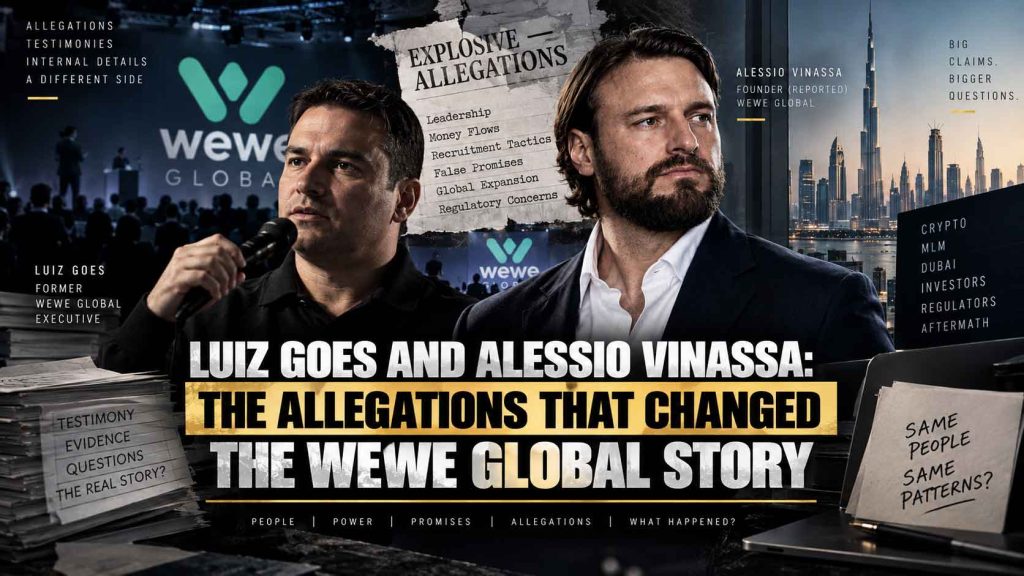
For years, the public story around WeWe Global was relatively straightforward. Luiz Goes was one of the most visible people associated with the operation. He presented himself as CEO of LyoPay, appeared in WeWe Global marketing presentations and became closely connected with the LyoFI and LyoPay phase of the business.
Then, in November 2025, Goes made a claim that changed the way I looked at the entire story.
He said Alessio Vinassa was the real owner of WeWe Global.
That allegation did not appear during the company’s launch. It came years later, after WeWe Global had already gone through multiple collapses and successor projects had appeared. That timing is important because it means the allegation itself needs to be examined carefully rather than simply accepted.
But it also means it cannot be ignored.
Why Luiz Goes matters
Goes was not an anonymous commenter who appeared years later with a theory about WeWe Global.
He had a documented public role in the operation.
BehindMLM reported that Goes presented himself as CEO of LyoPay and was involved in WeWe Global marketing presentations. During the LyoFI and LyoPay period, he became one of the main public faces of the ecosystem.
He later fronted The Blockchain Era as well, according to BehindMLM’s reporting. The Blockchain Era was described by the publication as another iteration of the WeWe Global ecosystem.
That history matters because Goes had first-hand access to people, companies and internal relationships that an outside observer would not necessarily have had.
It also means his later account comes with its own complications.
He was not simply an outside whistleblower.
He had been part of the operation he was describing.
The original explanation
In November 2025, Goes contacted BehindMLM asking for his name and photographs to be removed from eight articles.
In his initial explanation, Goes said he had been hired by VAI Marketing Management in Dubai as a contracted technical employee. He said his work was focused on fintech and blockchain development for group entities including LyoPay, LFI and LAYERK.
He also claimed that WeWe Global, Xera Pro and Homnifi were institutional clients of the companies for which he worked.
His position was essentially that he had been a technical employee and did not know that the clients he was working with might be operating fraudulent schemes.
But then came the part that changed the story.
In a subsequent email, Goes said the owner of WeWe Global was also the owner of VAI Marketing Management.
He named that person as Alessio Vinassa.
According to Goes, Vinassa was the majority shareholder of VAI Marketing and appeared as manager and majority shareholder on a Dubai commercial licence that Goes said he had attached to his correspondence with BehindMLM.
That is a much more specific allegation than the earlier online speculation connecting Vinassa to WeWe Global.
The Vinassa allegation
Goes went further.
He claimed that Vinassa and a person named Diego were the true controllers behind the operation, while people such as himself were essentially public-facing figures.
He also said that he had discovered more than 15 companies registered under his name after his US visa was denied at the Abu Dhabi Consulate. Goes said he had been receiving a salary of $5,000 while the people he identified as the true controllers remained wealthy.
These are Goes’ allegations.
They should not be presented as established facts without independent verification.
That is particularly important because BehindMLM itself stated that it had not independently confirmed who actually controlled WeWe Global. What it did have was Goes’ account and, according to its report, the Dubai corporate document that Goes supplied in support of his claim about Vinassa.
That leaves a very important distinction.
There is evidence that Goes publicly represented himself as LyoPay’s CEO and participated in WeWe Global presentations.
There is a documented corporate claim made by Goes concerning Vinassa’s ownership of VAI Marketing.
But the available material does not independently establish every part of Goes’ allegation about ultimate control of WeWe Global.
Why this changed the investigation
Before Goes named Vinassa, much of the public reporting around WeWe Global focused on Goes and the visible executives.
In fact, BehindMLM’s earlier reporting had considered the possibility that Goes himself was behind WeWe Global. The publication pointed to his position in Dubai, his involvement in marketing and his connection to LyoPay’s technology infrastructure. At the time, however, it said it could not definitively confirm that Goes was running WeWe Global.
That is important because it shows how uncertain the ownership question was.
The operation did not present a simple corporate structure where an outside investor could easily identify the person ultimately responsible.
Instead, there were multiple companies, executives, jurisdictions and brands.
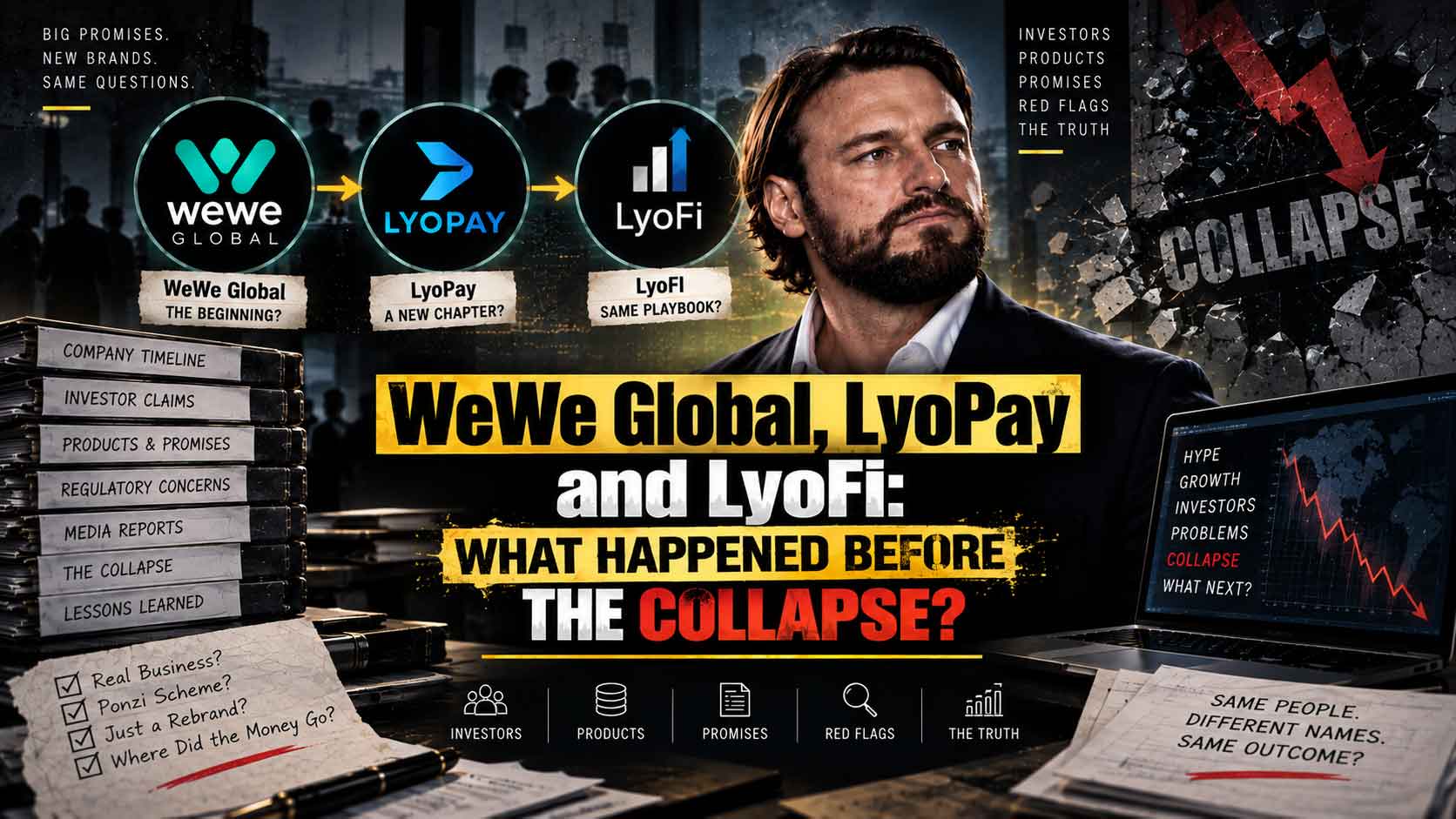
WeWe Global | LyoFI | LyoPay | LFI.
The Blockchain Era.
Later, Xera and Homnifi.
The corporate names changed, but the people around the ecosystem repeatedly overlapped.
And now a former public executive was pointing directly at Vinassa.
The regulatory record adds context
Goes’ allegation does not exist in isolation from the wider history of WeWe Global.
New Zealand’s Financial Markets Authority warned about WeWe Global and LYOPAY in 2023, later identifying The Blockchain Era as another name associated with WeWe Global. The warning concerned the provision of cryptocurrency products and services to New Zealand retail clients without the required registration or regulation.
The broader ecosystem continued after that warning. The Blockchain Era eventually collapsed and was followed by Xera, while Xera later became associated with Homnifi.
Australia’s ASIC subsequently placed WeWe Global on its Investor Alert List in April 2025, stating that it was likely offering financial services to Australian consumers without an Australian financial services or credit licence.
These regulatory actions do not prove Goes’ allegation about Vinassa.
They do, however, establish that the businesses at the centre of his allegations had attracted regulatory scrutiny.
The problem with taking either side at face value
This is where I think the Goes story needs to be handled differently from the way it is often discussed online.
It would be easy to say, “Luiz Goes exposed Vinassa.”
It would be just as easy to dismiss Goes completely because he was himself publicly involved in WeWe Global.
Neither approach answers the real question.
Goes had a role in the ecosystem. That makes his testimony potentially important, but it also gives readers a reason to examine his motives and credibility carefully.
The corporate document he reportedly provided is potentially more significant than an online accusation, but a document showing Vinassa’s position in VAI Marketing does not automatically prove that he controlled every company connected to WeWe Global.
The next step is therefore not simply to repeat what Goes said.
It is to verify it.
Who owned VAI Marketing?
Who owned WeWe Global?
Who controlled the bank accounts and cryptocurrency wallets?
Who incorporated the companies?
Who controlled the websites and technology?
Who received investor funds?
And did the ownership change when WeWe Global became LyoFI, LyoPay, LFI, The Blockchain Era and eventually Xera?
Those are the questions that could turn an allegation into something much more concrete.
A name that changed the story
Before Goes’ 2025 allegation, Alessio Vinassa was certainly mentioned in critical discussions around the broader cryptocurrency ecosystem, but the question of his exact role remained difficult to establish.
Goes changed that by putting a specific allegation on record.
He did not merely say Vinassa knew people involved in WeWe Global.
He alleged that Vinassa was the owner behind the operation and linked that claim to VAI Marketing and a Dubai commercial licence.
Whether that allegation ultimately survives independent scrutiny is another question.
But it changed the investigation.
Because once a former public executive points to a specific person and a specific corporate structure, the story is no longer just about what happened to WeWe Global.
It becomes a question of who was actually behind it.
And that is probably the most important unanswered question in the entire Vinassa story.